Use this guide as a working method, not a list of tricks. Read one section, apply it to a real activity, and keep the evidence that shows why each move works.
The short answer
The practical answer to how to create a sudoku task is to use one observable method, keep a record of what has already been inspected, and make the next decision from support on the worksheet. For teachers, task makers, Sudoku fans and anyone who wants to understand how a fair Sudoku is constructed, the main objective is to turn one valid completed grid into a playable task whose givens produce exactly one solution and whose intended difficulty comes from the logic required rather than from arbitrary clue removal. That is more reliable than moving faster, copying someone else's move or opening the answer material as soon as the exercise becomes uncertain.
A good practice block starts with a fully valid completed Sudoku grid, a copy used for tentative clue removal, a reliable uniqueness checker or exhaustive solver and a separate record of the logic needed by a human test solver. Those details sound ordinary, but they decide whether the participant can see the information, reverse a mistake and understand the next step. The task should feel demanding because of its intended thinking skill, not because the worksheet is cramped, the instructions are hidden or the controls are difficult to operate.
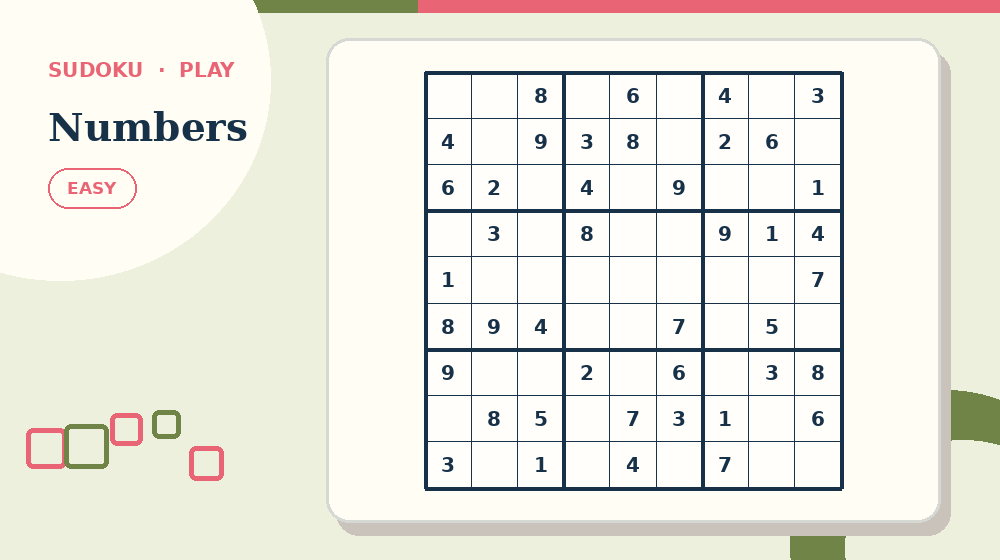
Start with Sudoku for Beginners when you want to test the setup on a complete activity rather than an isolated example.
Use the method in this guide on one complete sudoku exercise before collecting extra tips. Consistently applying a small set of habits produces a clearer improvement than applying a long list at random. When the task is complete, explain which clue or observation justified the final actions; that explanation is the best check that the method can be used again.
Understand what the activity is asking
Before starting, describe the task in one sentence without relying on its theme or decoration. For how to create a sudoku task: build, remove clues and test uniqueness, the action is to turn one valid completed grid into a playable task whose givens produce exactly one solution and whose intended difficulty comes from the logic required rather than from arbitrary clue removal. Naming that action keeps attention on the skill the worksheet is meant to practice instead of on whichever detail happens to look most noticeable.
Next, find what counts as support in this format: the digits already present in the same row, column and box, together with the candidates those digits eliminate. A choice that merely looks promising is not equivalent to one supported by the exercise. Teaching that distinction helps a beginner pause without feeling stuck and helps an experienced participant catch a careless assumption before it spreads.
Define completion before the first mark. Here, completion means that all 81 cells are filled and every row, column and 3×3 box contains the digits 1 through 9 exactly once. A observable endpoint makes progress easier to judge and stops the exercise from ending only because time or attention has run out.
Set up before you begin
Prepare a fully valid completed Sudoku grid, a copy used for tentative clue removal, a reliable uniqueness checker or exhaustive solver and a separate record of the logic needed by a human test solver. Put the task on a stable surface and remove unrelated sheets from the immediate workspace. On screen, use a comfortable zoom and make sure the main controls remain observable. On paper, keep an eraser or a second marking color available so tentative thinking does not become indistinguishable from a confirmed answer.
Read the title, instructions, legend and any word bank or clue list before making the first mark. This preview is not wasted time. It reveals the size of the task, the notation used by the author and any special requirement that changes the obvious strategy. It also gives the participant a chance to ask about unfamiliar vocabulary before that vocabulary is confused with task difficulty.
Pick a simple recording convention. Confirmed work should look different from a possibility, a tested branch or a discarded answer. Consistent marks lower working-memory load because the worksheet remembers earlier decisions. For group play, agree on the same convention aloud so one person's mark is meaningful to everyone else.
- Keep the full task and its instructions observable.
- Use reversible marks for uncertain work.
- Separate the participant sheet from the answer material.
- Agree what a finished and inspected result looks like.
A step-by-step method
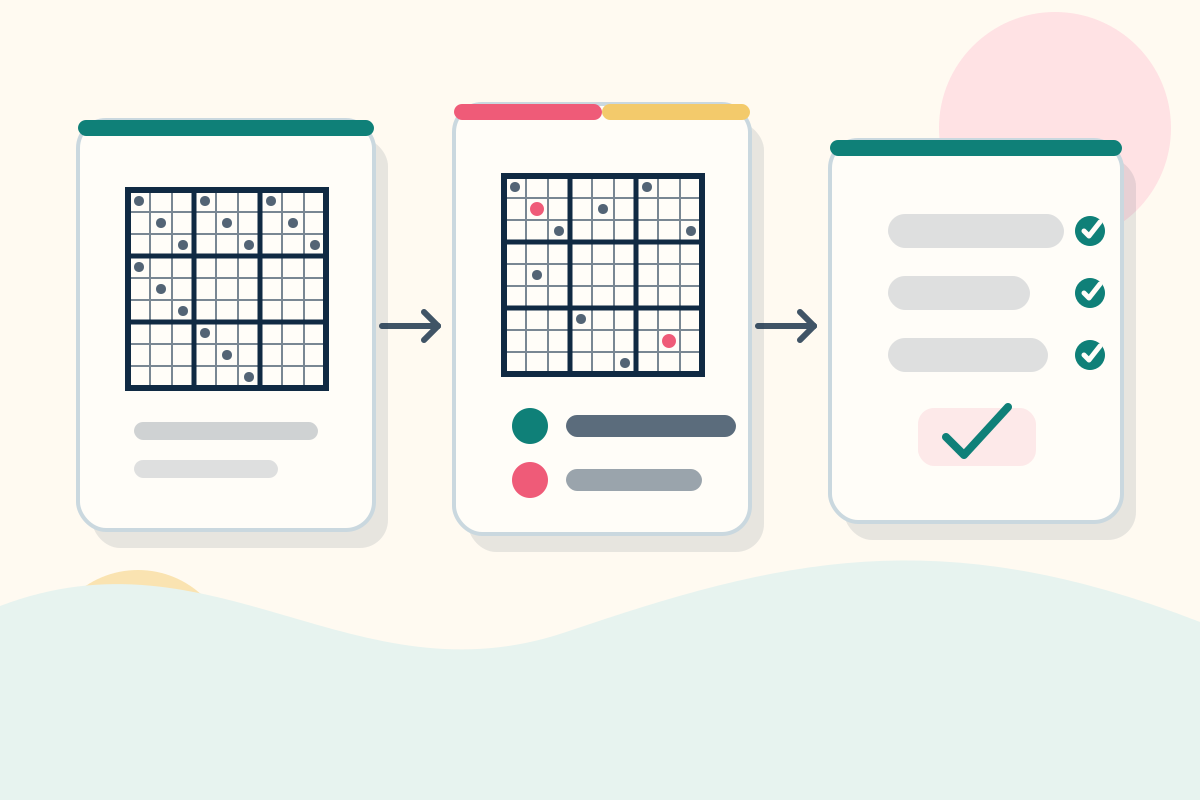
Step 1: build or obtain one complete valid grid in which every row, column and three-by-three box contains each digit from one through nine exactly once. Keep the scope of this step narrow enough that it can be finished and inspected. Work from one edge, unit, clue group or caller record to the other, then mark the pass as complete. Order matters because it prevents attractive details from pulling attention back to places already reviewed.
Step 2: remove one given or one symmetric pair at a time while preserving a saved copy of the full solution so every change can be reversed without rebuilding the grid. Use this step to create information for the following decision. Review the result with the stated requirement before writing permanently, and correct the smallest possible area if they disagree. The method should leave a observable trail that makes resuming or explaining the task straightforward.
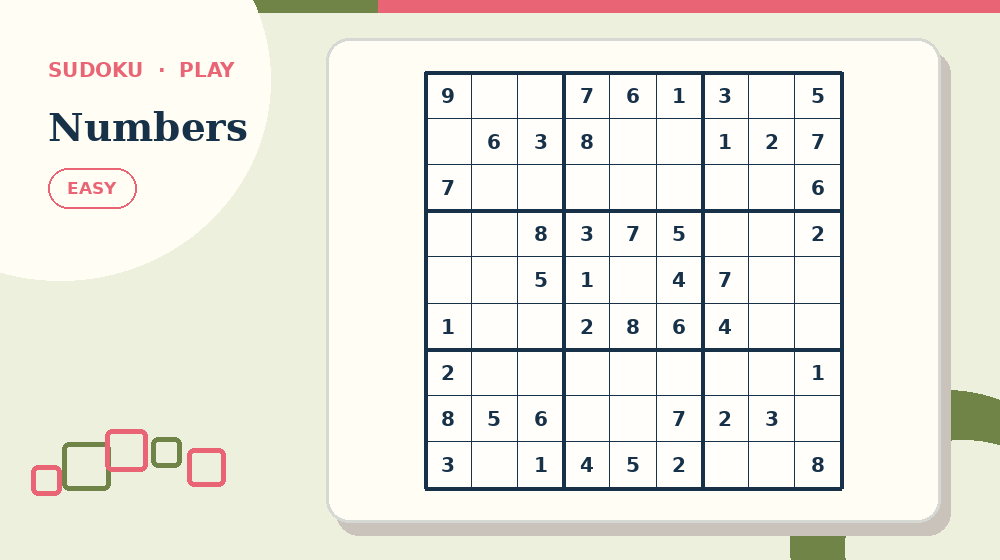
Apply these first two decisions in Easy Sudoku; leave the page open beside this section and return only when you can explain the evidence for the next step.
Step 3: after each removal verify that the remaining givens still permit exactly one solution, restoring a clue immediately whenever the task becomes ambiguous. Treat this as an observable action rather than a vague reminder to concentrate. Name the clue, line, cell, card or option you are using and state what it rules out. When nothing is found, preserve that result instead of immediately repeating the same search from a different starting point.
Step 4: test-solve the surviving task with the techniques appropriate to the target level and record the hardest required step instead of estimating difficulty only from the number of givens. Keep the scope of this step narrow enough that it can be finished and inspected. Work from one edge, unit, clue group or caller record to the other, then mark the pass as complete. Order matters because it prevents attractive details from pulling attention back to places already reviewed.
Step 5: perform a final independent validation of the givens, unique solution and displayed answer key before sharing or printing the task, then let a fresh solver check whether the intended path feels fair. Treat this as an observable action rather than a vague reminder to concentrate. Name the clue, line, cell, card or option you are using and state what it rules out. When nothing is found, preserve that result instead of immediately repeating the same search from a different starting point.
A worked practice example
Consider this example: starting with a completed nine-by-nine solution, removing a rotationally symmetric pair of givens, running a uniqueness check, then test-solving the result and restoring one clue when the removal creates a second valid completion. Restate the exact target and find the information already supplied by the worksheet before making a permanent mark. Point to the first practical constraint and name the alternatives it removes. That creates a short chain of reasoning another person can follow and challenge.
Use the first two steps in order. First, build or obtain one complete valid grid in which every row, column and three-by-three box contains each digit from one through nine exactly once. Next, remove one given or one symmetric pair at a time while preserving a saved copy of the full solution so every change can be reversed without rebuilding the grid. If the support conflicts with an early hunch, keep the support and discard the hunch. The aim is a result that survives every relevant check, not a defence of the first idea that came to mind.
For the third step, after each removal verify that the remaining givens still permit exactly one solution, restoring a clue immediately whenever the task becomes ambiguous. Pause and inspect the surrounding information instead of staring only at the current detail. Many errors start when a locally attractive choice hides a condition elsewhere on the worksheet. One wider check is faster than repairing several dependent choices later.
Finish with the verification that belongs to this format: scan every row, column and box for duplicates, then review the finished grid with the recorded solution. This final pass turns a plausible result into a completed exercise and gives the participant a precise place to look if something does not agree.
How to adjust the difficulty
Change one variable at a time. For this format, the variables that genuinely affect difficulty are clue count, candidate density, the solving techniques required and how many logical steps must be chained together. If several change together, it becomes difficult to know which one made the exercise more accessible or more demanding.
For a gentler version, keep the same theme but narrow the number of competing possibilities. Concentrate on one action: build or obtain one complete valid grid in which every row, column and three-by-three box contains each digit from one through nine exactly once. Use generous spacing, a shorter set or a partly completed example. Support should expose the reasoning while leaving the next decision to the participant.
For a stronger challenge, preserve the same basic requirements and ask for this action without prompting: test-solve the surviving task with the techniques appropriate to the target level and record the hardest required step instead of estimating difficulty only from the number of givens. Add complexity only after the participant can explain the easier method. Productive difficulty creates more meaningful decisions; poor difficulty merely adds tiny print, ambiguous wording or hidden instructions.
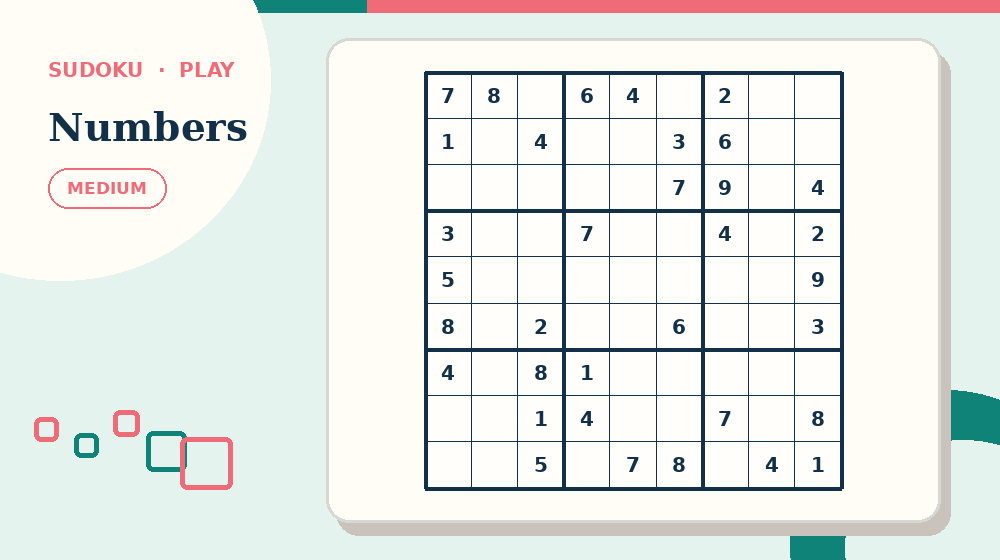
To compare the change at a nearby level, open Medium Sudoku and change one difficulty variable instead of changing the whole routine at once.
Watch behavior instead of relying only on the final score. Repeated random marks, long periods without a plan or refusal to check work signal that the level may be too high or the method unclear. Fast completion with no explanation may signal that the level is too low. Adjust the next task, not the participant's confidence.
Common mistakes and what to do instead
Avoid assuming that fewer givens automatically make a Sudoku harder. Pause at the first observable contradiction and return to the last confirmed point. Name the requirement that should control the next decision, restore only the information affected by the error, and continue from support rather than from the same hunch.
Avoid removing many clues at once and discovering too late which removal created multiple solutions. Pause at the first observable contradiction and return to the last confirmed point. Name the requirement that should control the next decision, restore only the information affected by the error, and continue from support rather than from the same hunch.
Avoid treating a task as valid merely because one solution can be found without proving that a second solution is impossible. A good recovery is smaller than a restart. Review the questionable choice with the instructions and shared record, explain exactly why it fails, then correct that one branch. Keeping the rest of the valid work protects both confidence and practical information.
Avoid rating difficulty from clue count alone while ignoring which logical techniques the remaining pattern requires. Prevent it by adding a short checkpoint before permanent marks. Ask what fact makes the choice legal and what would disprove it. If neither question has an answer, leave the choice open and gather another clue instead of forcing progress.
Avoid publishing a generated Sudoku without independently inspecting the givens, unique solution and answer key against one another. Pause at the first observable contradiction and return to the last confirmed point. Name the requirement that should control the next decision, restore only the information affected by the error, and continue from support rather than from the same hunch.
Build a checklist for How to Create a Sudoku Puzzle: Build, Remove Clues and Test Uniqueness
Turn the method into a short checklist that can sit beside the exercise. Write the target first: turn one valid completed grid into a playable task whose givens produce exactly one solution and whose intended difficulty comes from the logic required rather than from arbitrary clue removal. Under that line, record the support that belongs to this format—the digits already present in the same row, column and box, together with the candidates those digits eliminate. This prevents a checklist from becoming a generic reminder to 'be careful'; every item should point to something the participant can actually see, say or verify.
Make the first checkpoint specific: build or obtain one complete valid grid in which every row, column and three-by-three box contains each digit from one through nine exactly once. The second checkpoint is different: remove one given or one symmetric pair at a time while preserving a saved copy of the full solution so every change can be reversed without rebuilding the grid. Keep both as complete actions rather than reducing them to one-word labels. A participant returning after a pause should be able to read either line and know exactly what to inspect next without reconstructing the whole article.
Use the middle of the checklist for the decisions most likely to be skipped: after each removal verify that the remaining givens still permit exactly one solution, restoring a clue immediately whenever the task becomes ambiguous. Follow that with test-solve the surviving task with the techniques appropriate to the target level and record the hardest required step instead of estimating difficulty only from the number of givens. Put a small box beside each action, but tick it only after the action is complete. The boxes are a record of work already performed, not a score and not a substitute for explaining why the result is valid.
Add one recovery note based on the most relevant errors: avoid assuming that fewer givens automatically make a Sudoku harder, and watch for removing many clues at once and discovering too late which removal created multiple solutions. If either appears, return to the most recent confirmed support instead of restarting the complete exercise. Finish the checklist with the final action—perform a final independent validation of the givens, unique solution and displayed answer key before sharing or printing the task, then let a fresh solver check whether the intended path feels fair—and the format check: scan every row, column and box for duplicates, then review the finished grid with the recorded solution.
Test the checklist against the worked situation rather than reading it in the abstract: starting with a completed nine-by-nine solution, removing a rotationally symmetric pair of givens, running a uniqueness check, then test-solving the result and restoring one clue when the removal creates a second valid completion. Cover the article, follow the written checkpoints and notice where the checklist leaves you unsure. Rewrite that line with the missing object, location or stopping condition. A practical checklist becomes shorter as its actions become more precise; it does not become a second copy of the tutorial.
Store the checklist with a fully valid completed Sudoku grid, a copy used for tentative clue removal, a reliable uniqueness checker or exhaustive solver and a separate record of the logic needed by a human test solver. On the next attempt, use it only at the beginning, after a contradiction and during final verification. If the participant can carry out perform a final independent validation of the givens, unique solution and displayed answer key before sharing or printing the task, then let a fresh solver check whether the intended path feels fair without looking back at the article, the checklist is supporting independent work. If it repeatedly leads to treating a task as valid merely because one solution can be found without proving that a second solution is impossible, revise the wording before increasing the difficulty.
Before sharing the checklist, run one final failure test. Ask whether it prevents rating difficulty from clue count alone while ignoring which logical techniques the remaining pattern requires and whether a new participant could still fall into publishing a generated Sudoku without independently inspecting the givens, unique solution and answer key against one another. Add one concrete warning only when it changes an action; vague cautions create visual noise. The finished checklist should explain what to do, what support confirms it and when to stop, correct or continue.
- Target: turn one valid completed grid into a playable task whose givens produce exactly one solution and whose intended difficulty comes from the logic required rather than from arbitrary clue removal.
- First action: build or obtain one complete valid grid in which every row, column and three-by-three box contains each digit from one through nine exactly once.
- Independent check: test-solve the surviving task with the techniques appropriate to the target level and record the hardest required step instead of estimating difficulty only from the number of givens.
- Final verification: scan every row, column and box for duplicates, then review the finished grid with the recorded solution.
Teaching, family and group use
When using this guide with teachers, task makers, Sudoku fans and anyone who wants to understand how a fair Sudoku is constructed, model one complete decision rather than completing the whole exercise. Say what you notice, what you can eliminate and why the remaining step is justified. Then hand control back. The participant needs to practice choosing the support, not merely watch a polished solution.
Use questions that reveal process: What have you inspected? Which requirement applies here? What would make this answer impossible? Where will you look next? These prompts are more practical than asking whether the participant is sure. They allow help without converting the exercise into a sequence of hints supplied by the adult or host.
If the learner needs another explanation of the same format, continue with How to Play Sudoku: A Beginner’s Guide before supplying an answer.
In pairs, assign roles that rotate. One person can point or mark while the other checks the requirement, clue list or caller record. Switch after a small milestone. This prevents one confident participant from taking every move and gives both people a concrete responsibility.
End with a one-minute reflection. Ask which strategy found the most information, where the first error appeared and what the participant will do first on the next exercise. Keep the reflection specific to observable actions. General praise feels pleasant; specific feedback makes the skill portable.
A focused 15-minute practice routine
Minute 0–2: preview the worksheet, read the requirements and pick the recording convention. Name the method you will practice. This short setup keeps the practice block from becoming an unstructured race and makes later reflection possible.
Minute 2–7: carry out two actions in order. First, build or obtain one complete valid grid in which every row, column and three-by-three box contains each digit from one through nine exactly once. Next, remove one given or one symmetric pair at a time while preserving a saved copy of the full solution so every change can be reversed without rebuilding the grid. Do not measure speed yet. Put a small neutral mark beside any decision that remains uncertain, then continue with information that can be confirmed.
Minute 7–12: move to the harder area. Use this check: after each removal verify that the remaining givens still permit exactly one solution, restoring a clue immediately whenever the task becomes ambiguous. Then apply this follow-up: test-solve the surviving task with the techniques appropriate to the target level and record the hardest required step instead of estimating difficulty only from the number of givens. If the exercise is complete, verify it instead of opening another worksheet immediately. If it is unfinished, stop at a clear point and summarize what remains so the practice block can resume without repeating work.
Minute 12–15: check the answer material only after recording a final result or a specific unresolved question. Review methods, not just solutions. Pick the next task at the same level if the reasoning was inconsistent, or one neighboring level harder if the method felt controlled.
Print, screen and accessibility choices
Use the original PDF for printing because it preserves the intended grid proportions and line weight. Print one proof at actual size before a batch. On a narrow A4 printer, inspect the preview carefully rather than accepting automatic shrinkage. Keep answer pages out of participant sets unless self-checking is part of the exercise.
On screen, increase browser zoom until text is comfortable, then validate that controls remain reachable and the task itself still fits the available space. Use keyboard, touch or mouse according to the participant's motor comfort. Reduced motion should not remove status messages or progress information.
For visual tracking, use strong light without glare and introduce a ruler edge, reading strip or focus mode when the worksheet becomes difficult to follow. Preserve the support that matters for this format—the digits already present in the same row, column and box, together with the candidates those digits eliminate—at a comfortable size and contrast. Accessibility changes how information is presented; it does not need to remove the reasoning that makes the exercise satisfying.
How to know the method is working
The clearest sign of improvement is not a single fast time. Look for fewer unsupported actions, cleaner corrections, more complete scans and explanations that refer to the actual requirements. A participant who can recover from an error has learned more than a participant who happened to guess the right branch.
Repeat a similar sudoku exercise within a day or two and start without rereading the whole guide. If the participant independently uses at least two of the method steps, the routine is becoming available from memory. If not, shorten the next practice block and practice one step in isolation.
Keep a tiny practice record with the task title, level, time spent, strategy used and one sentence about the hardest decision. Do not turn the record into a public ranking. Its purpose is to pick the next practical exercise and to make gradual progress observable.
Test the skill on a fresh puzzle
Use one of the fresh sudoku practice pages linked in this guide rather than repeating the worked example. Before starting, write down two actions: build or obtain one complete valid grid in which every row, column and three-by-three box contains each digit from one through nine exactly once. Then, remove one given or one symmetric pair at a time while preserving a saved copy of the full solution so every change can be reversed without rebuilding the grid. Put the article aside and try to recognise the right moment for each action without copying the demonstration wording.
After the second worksheet, review one successful decision with one moment of uncertainty. Ask whether this step supplied enough support—after each removal verify that the remaining givens still permit exactly one solution, restoring a clue immediately whenever the task becomes ambiguous—and whether the participant avoided this common error: assuming that fewer givens automatically make a Sudoku harder. Record one specific adjustment for the next attempt. That comparison turns how to create a sudoku task into a transferable skill instead of a one-worksheet performance.
Frequently asked questions
What is the best first step for how to create a sudoku task?
Preview the complete exercise, then make the first action explicit: build or obtain one complete valid grid in which every row, column and three-by-three box contains each digit from one through nine exactly once. This gives you an ordered starting point and reduces the temptation to make a random mark before the requirements and available information are clear.
Should I use a timer?
Use a timer only after the method is accurate. A quiet elapsed-time display can help review your own sessions, but a countdown often encourages guesses, incomplete inspecting and avoidable motor errors. For children and new participants, finish one logical milestone instead of racing a clock.
When should I look at the answer?
Look after you have a complete result or a precisely stated point of uncertainty. First record what you tried and which requirement stopped progress. Then review the relevant part of the answer material. This makes inspecting a learning step rather than a substitute for solving.
How do I make a sudoku exercise easier without giving away the answer?
Lower one source of complexity and keep the core requirement. You might provide larger print, fewer choices or a shorter set, then demonstrate one action: remove one given or one symmetric pair at a time while preserving a saved copy of the full solution so every change can be reversed without rebuilding the grid. Ask the participant to make the next decision independently.
How often should I practice?
Two or three focused sessions each week are enough for most recreational solvers. Stop while the participant can still explain the method. Short, repeated practice with a nearby difficulty is more practical than one long practice block that ends in fatigue and random guessing.
Can this method be used on paper and online?
Yes. The reasoning is the same. Online controls can save progress and provide reversible input, while paper makes annotations and group discussion easy. Pick the format that keeps the task readable and lets the participant distinguish tentative work from confirmed solutions.