Use this guide as a working method, not a list of tricks. Read one section, apply it to a real activity, and keep the evidence that shows why each move works.
The short answer
Put target answers on varied bingo cards and read definitions, examples or questions aloud. Learners must identify the matching term before marking it.
Give individual listening time, keep called clues visible and pause periodically for a learner to explain one match. The first bingo is a checkpoint, not the end of learning.
Before continuing, open Conversation Bingo and practise this first move: put answers on cards and read clues aloud. The complete activity makes the setup advice above easier to judge than an isolated example.
Close with a retrieval task using marked terms after cards are covered. This distinguishes recognition during play from knowledge that can be recalled independently.
Understand the exact job of this activity
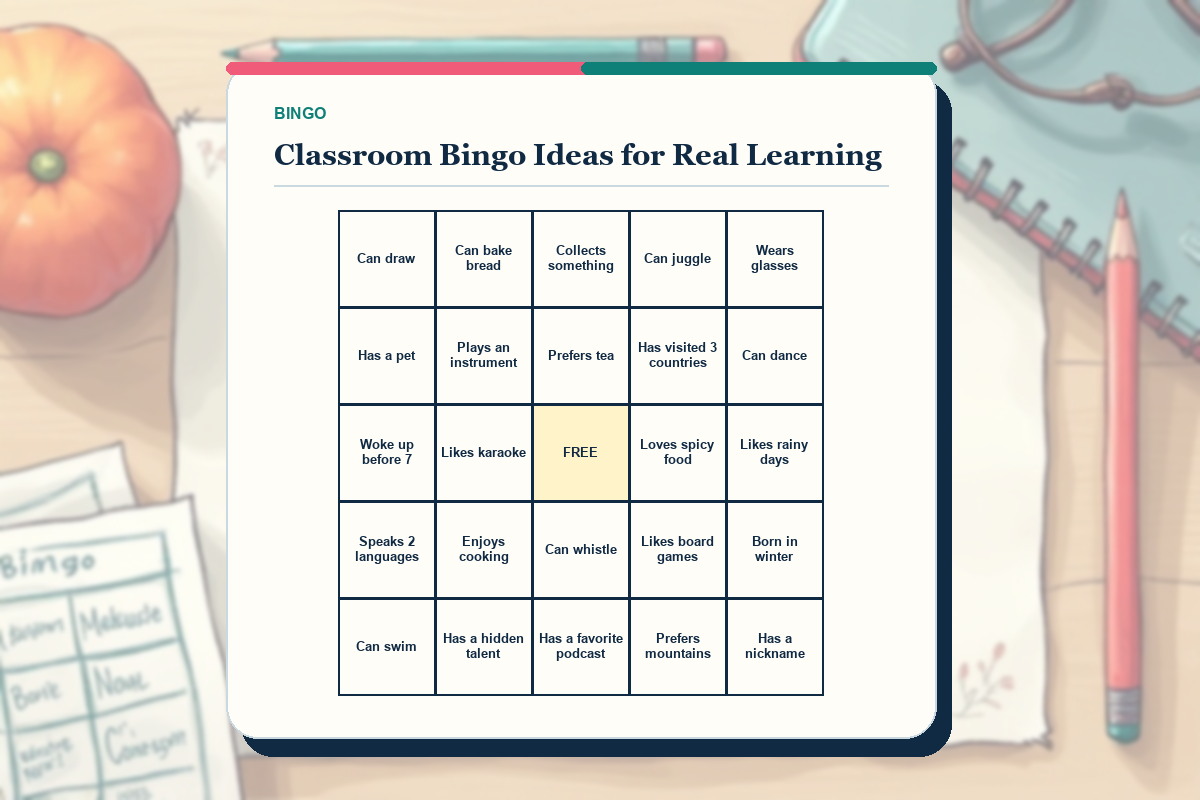
In Classroom Bingo Ideas for Real Learning, success means you can make each marked square evidence of listening, recall or application. The relevant evidence is the caller record, the exact items marked on the card and the winning pattern announced before the round. Decoration, familiarity with the theme and confidence are not evidence by themselves.
Use one card cell, the exact call that supports it and the announced winning pattern to keep the decision local. Start by doing this: put answers on cards and read clues aloud. If you cannot name what changed, do not add another permanent answer or mark.
Measure progress by this standard: count verified calls and completed patterns, not the number of markers scattered on a card. When progress stops, return to this method: pause for a learner to explain selected matches. State the reason for changing approach before you make the next move.
Prepare the materials and the decision record
For Classroom Bingo Ideas for Real Learning, lay out a learning objective, varied cards and caller prompts that require the intended skill. Keep any answer material closed or out of reach until the attempt has a complete result or a precisely stated question.
On paper, print distinct cards at actual size and use markers that do not hide the words or pictures. On screen, tap only the matching cell and leave the caller history available during verification. Check the real input method before starting so a print, zoom or touch problem is not mistaken for puzzle difficulty.
Record uncertain work this way: keep a caller list in order and use removable markers until a win has been checked. If teachers, tutors and homeschool groups pause and return later, the record should show what is confirmed, what is provisional and what was rejected.
- Goal: make each marked square evidence of listening, recall or application.
- First action: put answers on cards and read clues aloud.
- Working unit: one card cell, the exact call that supports it and the announced winning pattern.
- Final check: read the claimed pattern cell by cell and match every marked item against the caller record.
Run one learning bingo round
Step 1 - Show the pattern and model one clue-to-square match. Explain the reasoning without marking a live game item.
Step 2 - Read one clue, give silent processing time and repeat once. Learners mark only after deciding individually.
Use Christmas Bingo for the next pass. Try to include examples and non-examples in the caller list without opening the answer material, then return here and name the evidence that supported the decision.
Step 3 - Keep the clue visible or recorded, then ask one learner to explain a selected match. Correct misconceptions before the next call.
Step 4 - Verify a bingo against the caller record. Continue with a second pattern or finish the planned clue set so remaining content is not skipped.
Step 5 - Cover the cards and ask learners to retrieve or use three marked terms from memory.
Worked example: science vocabulary
Place science terms such as evaporation, habitat and conductor on varied cards. The caller reads definitions or short scenarios instead of saying the terms.
After several calls, ask learners to compare one uncertain square and cite the phrase that supported the match. Do not reveal unrelated squares.
At the end, learners choose two marked terms and write a sentence or diagram showing the meaning. Record misunderstandings for the next lesson.
Decision log for the worked example
For the Classroom Bingo Ideas for Real Learning example, log the first observation created by this action: put answers on cards and read clues aloud. Write the observation itself, not a vague note that the step was completed.
Next, record what changed after you pause for a learner to explain selected matches. If nothing changed, keep that result; an explicit no-change result prevents the same unproductive pass from being repeated.
Close the log with the final check: read the claimed pattern cell by cell and match every marked item against the caller record. If the check fails, identify the earliest unsupported decision and connect it to one risk: placing the same words in the same positions.
Diagnostic questions for Classroom Bingo Ideas for Real Learning
Can you explain why put answers on cards and read clues aloud is the correct opening for classroom bingo ideas? If not, restate the goal - make each marked square evidence of listening, recall or application - before making another mark.
Does the current record follow this rule: keep a caller list in order and use removable markers until a win has been checked? If not, separate confirmed work from possibilities before the next method.
Which evidence supports the current decision: the caller record, the exact items marked on the card and the winning pattern announced before the round? Remove any answer supported only by familiarity or appearance.
Have you checked for this specific failure: using decorative vocabulary unrelated to the lesson? Repair that issue locally instead of restarting unrelated work.
Can the final result pass this test: read the claimed pattern cell by cell and match every marked item against the caller record? If not, leave the activity marked as unfinished and record the exact failing unit.
Adjust difficulty without changing the core skill
For an easier bingo activity, reduce card vocabulary, recognition speed, winning pattern, number of possible calls and whether clues replace direct calls while preserving the goal to make each marked square evidence of listening, recall or application. Keep the same opening method: put answers on cards and read clues aloud.
For a harder classroom bingo ideas task, add one source of complexity at a time. Continue to require this evidence: the caller record, the exact items marked on the card and the winning pattern announced before the round. More decoration, smaller print or longer instructions do not create useful difficulty.
Now compare the method on Office Bingo Cards. Keep the goal—make each marked square evidence of listening, recall or application—but change only the difficulty or theme, so the comparison shows whether the routine transfers.
For teachers, tutors and homeschool groups, adjust the amount of material, available time or input method before removing the reasoning step. Assistance should make the evidence reachable without supplying the result.
Common mistakes and precise recovery actions
Watch for this first failure in Classroom Bingo Ideas for Real Learning: placing the same words in the same positions. Stop, restore one card cell, the exact call that supports it and the announced winning pattern and repeat this action: put answers on cards and read clues aloud.
A second risk is using decorative vocabulary unrelated to the lesson. Compare the current work with the caller record, the exact items marked on the card and the winning pattern announced before the round; keep only decisions that the evidence supports.
If you notice letting visual copying replace listening, return to this method: pause for a learner to explain selected matches. Record the corrected result before touching any later answer.
When making clues longer than working memory can hold occurs, use this recovery procedure: pause the round, compare the claimed cells with the caller record, remove unsupported markers and restart from the next valid call. Continue only when the progress measure changes for a stated reason.
Prevent the final failure - treating the first winner as the end of learning - by completing this action: end with a short retrieval task using marked terms. Then run the verification for classroom bingo ideas: read the claimed pattern cell by cell and match every marked item against the caller record.
Build a checklist for Classroom Bingo Ideas for Real Learning
Write the Classroom Bingo Ideas for Real Learning goal first: make each marked square evidence of listening, recall or application. Under it, copy this opening action: put answers on cards and read clues aloud. Leave space for the result, not merely a tick box.
Add the second and third checks in order: include examples and non-examples in the caller list; then pause for a learner to explain selected matches. Beside both, print the record rule: keep a caller list in order and use removable markers until a win has been checked.
Reserve a separate line for the hard-area pass: use multiple card versions. Name the exact unit inspected so a later correction does not erase unrelated progress.
End the checklist with this action: end with a short retrieval task using marked terms. Follow it immediately with the verification statement: read the claimed pattern cell by cell and match every marked item against the caller record.
Test the checklist against the worked case - reviewing science vocabulary by calling definitions while learners mark the matching terms. Rewrite any item that still needs the full article to explain what object to inspect or when to stop.
- Open with: put answers on cards and read clues aloud.
- Develop with: include examples and non-examples in the caller list.
- Discriminate with: pause for a learner to explain selected matches.
- Resolve with: use multiple card versions.
- Close with: end with a short retrieval task using marked terms.
Collect learning evidence fairly
Circulate with notes for clue comprehension, accurate matching and explanation. Keep these observations separate from game wins.
Use simultaneous marking and occasional explanation so one fast learner does not answer for a table.
If the step in “Collect learning evidence fairly” is still unclear, continue with How to Play Bingo: Rules for Any Group. It approaches the same puzzle format from a different decision point before you need to reveal an answer.
For home practice, let an adult read the caller clues in random order and ask for one explanation before confirming a mark.
A focused learning-bingo routine
Minutes 0-3: model one clue-to-answer match and confirm the pattern without using a live item.
Minutes 3-8: call four reviewed clues with silent individual processing before each mark.
Minutes 8-11: pause for two learners to explain different matches and correct one misconception.
Minutes 11-15: finish the mini-round, cover cards and retrieve three terms without visual support.
Keep learning access separate from answer copying
Print varied cards with readable terms and enough marker space. Keep card identifiers outside the learning grid.
Online, show the clue and call history while hiding the exact answer until marking time closes.
Provide audio replay, larger text or response alternatives when needed, but preserve the learner's clue-to-answer decision.
Check knowledge after the markers are put away
The activity works when learners can retrieve or apply marked terms without seeing their cards and can explain why a clue matched.
Repeat missed concepts later in another form, not the same caller order. Improvement should transfer to new examples.
If bingo results are strong but exit responses are weak, simplify the card game and strengthen the explanation pauses.
Use a three-column observation sheet during one round: understood the spoken clue, selected the matching term and explained the relationship. Mark observed, prompted or not yet seen. A learner may succeed at one stage and need support at another, so avoid collapsing the columns into a single win score.
After the round, choose two widely missed terms and reteach them with examples and non-examples. Schedule a new retrieval prompt after other lesson content, using a different card position or no bingo card at all. Delayed success is stronger evidence than remembering where a square appeared.
Compare audio-only, written-clue and combined access for a small sample when results are inconsistent. Keep the underlying concept and answer set stable. If written support improves matching without changing explanation quality, retain it as access rather than labelling the original miss as weak knowledge.
Store lesson notes by topic, not by public player ranking. Record which clue wording confused the class, which explanation corrected it and what follow-up is planned. Revise the caller source before reuse so the same ambiguity is not treated as a fresh learner error.
Confirm that the revised clue still maps to one answer before the next class. Record that check.
Test the skill on a fresh puzzle
Open one linked bingo page and write down two actions before starting: put answers on cards and read clues aloud, followed by include examples and non-examples in the caller list. Put Classroom Bingo Ideas for Real Learning aside during the attempt.
At the first uncertain point, use this method without prompting: pause for a learner to explain selected matches. Compare one confirmed result with one unresolved result and name the evidence separating them.
Complete the fresh attempt by doing this: end with a short retrieval task using marked terms. Run the same final check - read the claimed pattern cell by cell and match every marked item against the caller record - and record one specific adjustment for the next page.
Frequently asked questions
What should I do first in Classroom Bingo Ideas for Real Learning?
Begin with the catalogued opening action for classroom bingo ideas: put answers on cards and read clues aloud. Apply it to one card cell, the exact call that supports it and the announced winning pattern and record the result before moving to include examples and non-examples in the caller list.
How can I tell whether my classroom bingo ideas method is producing real progress?
For this bingo task, use the progress test 'count verified calls and completed patterns, not the number of markers scattered on a card'. A new mark counts only when it can be connected to the caller record, the exact items marked on the card and the winning pattern announced before the round.
What should I do if I notice placing the same words in the same positions?
Stop at the first affected unit and use the format-specific recovery: pause the round, compare the claimed cells with the caller record, remove unsupported markers and restart from the next valid call. Resume Classroom Bingo Ideas for Real Learning with pause for a learner to explain selected matches instead of repeating the unsupported move.
When is it appropriate to check the answer for Classroom Bingo Ideas for Real Learning?
Check after completing this final action: end with a short retrieval task using marked terms. Before opening the answer, write the exact unresolved point and test whether read the claimed pattern cell by cell and match every marked item against the caller record.
How can I make this bingo practice more accessible?
Change size, spacing, session length or input method while preserving the caller record, the exact items marked on the card and the winning pattern announced before the round. On paper, print distinct cards at actual size and use markers that do not hide the words or pictures. On screen, tap only the matching cell and leave the caller history available during verification.
What should I practise after Classroom Bingo Ideas for Real Learning?
Choose a nearby classroom bingo ideas page and repeat two actions without reopening the article: put answers on cards and read clues aloud; then pause for a learner to explain selected matches. Finish by checking that read the claimed pattern cell by cell and match every marked item against the caller record.