Use this guide as a working method, not a list of tricks. Read one section, apply it to a real activity, and keep the evidence that shows why each move works.
The short answer
Would You Rather works when both options are heard together, choosing is voluntary and nobody has to defend a private preference. Read one prompt, allow quiet thinking time, invite a choice or a pass, and ask one neutral follow-up. The conversation matters more than reaching agreement.
Before the first round, tell the group that there is no correct side. A player may change their mind after hearing another reason, and a pass needs no explanation. These two rules prevent a playful choice from turning into a test of confidence, popularity or personal disclosure.
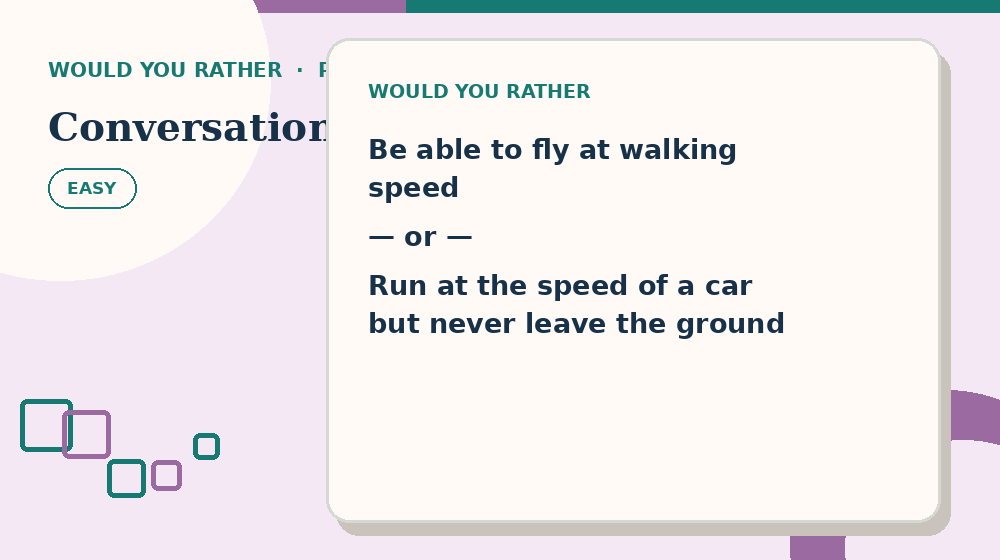
Before continuing, open Would You Rather and practise this first move: read both options without signaling a preferred answer. The complete activity makes the setup advice above easier to judge than an isolated example.
Use a small reviewed set instead of racing through a long list. Five prompts with real discussion usually produce a better session than thirty prompts answered in one word. Stop while people are still listening to one another, not after every card has been exhausted.
Understand the exact job of this activity
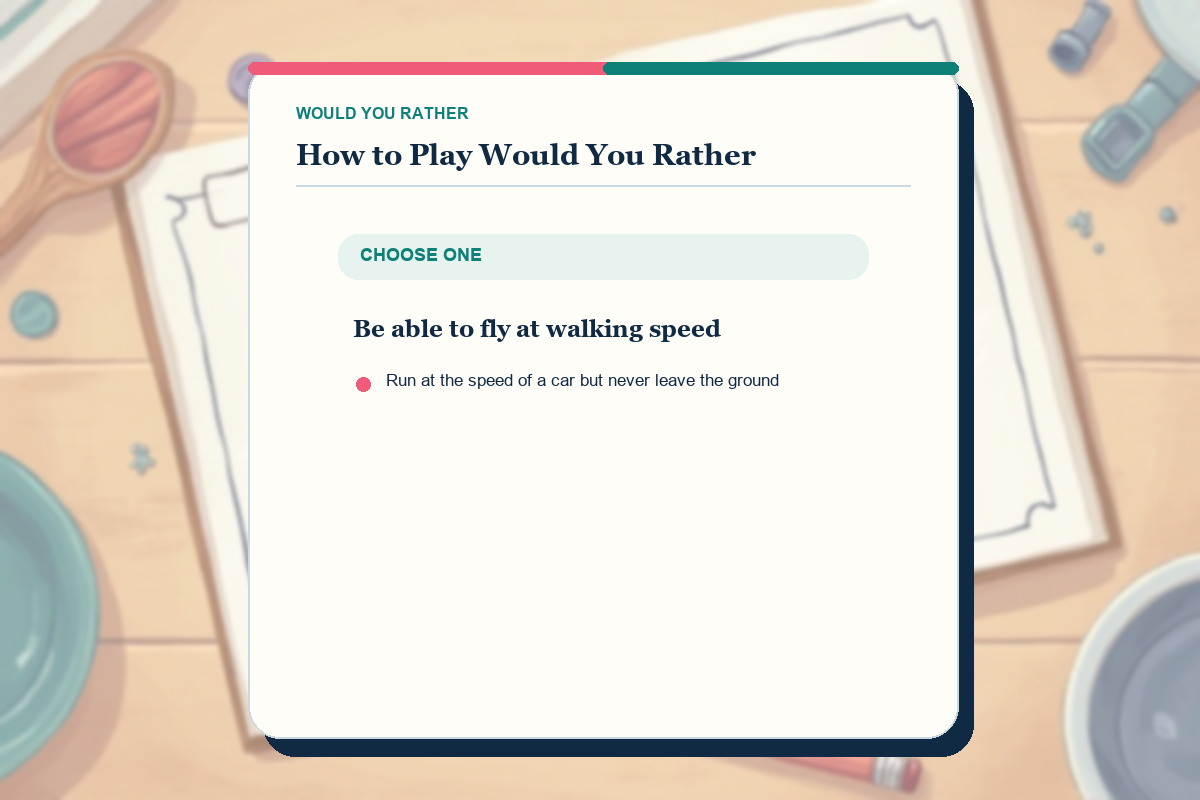
In How to Play Would You Rather, success means you can move from a quick choice to a respectful explanation and shared discussion. The relevant evidence is the two stated options, the reason a participant gives and the discussion rule that keeps both choices acceptable. Decoration, familiarity with the theme and confidence are not evidence by themselves.
Use one pair of options, one participant's choice and the reason they are comfortable sharing to keep the decision local. Start by doing this: read both options without signaling a preferred answer. If you cannot name what changed, do not add another permanent answer or mark.
Measure progress by this standard: track balanced participation and completed discussions rather than agreement between players. When progress stops, return to this method: ask each player to choose before debating. State the reason for changing approach before you make the next move.
Prepare the materials and the decision record
For How to Play Would You Rather, lay out a reviewed prompt set, a turn order and permission to pass on any question. Keep any answer material closed or out of reach until the attempt has a complete result or a precisely stated question.
On paper, cut prompt cards so both choices remain on the same card and remove unsuitable prompts beforehand. On screen, show both options together, allow a pass and move to the next prompt without exposing private input. Check the real input method before starting so a print, zoom or touch problem is not mistaken for puzzle difficulty.
Record uncertain work this way: note optional follow-up ideas without scoring preferences as right or wrong. If families, classrooms, youth groups and team gatherings pause and return later, the record should show what is confirmed, what is provisional and what was rejected.
- Goal: move from a quick choice to a respectful explanation and shared discussion.
- First action: read both options without signaling a preferred answer.
- Working unit: one pair of options, one participant's choice and the reason they are comfortable sharing.
- Final check: repeat the selected option and its reason without changing the participant's meaning or treating preference as correctness.
Run one complete turn
Step 1 — Read both options exactly as written. Keep your voice and facial expression neutral. If the wording needs a long explanation, replace the prompt; the choice should be clear before anyone starts defending a side.
Step 2 — Give five to ten seconds of quiet thinking time. Do not let the fastest speaker define the discussion. In a young group, repeat both options once and point to the matching visual cards without suggesting which side is easier.
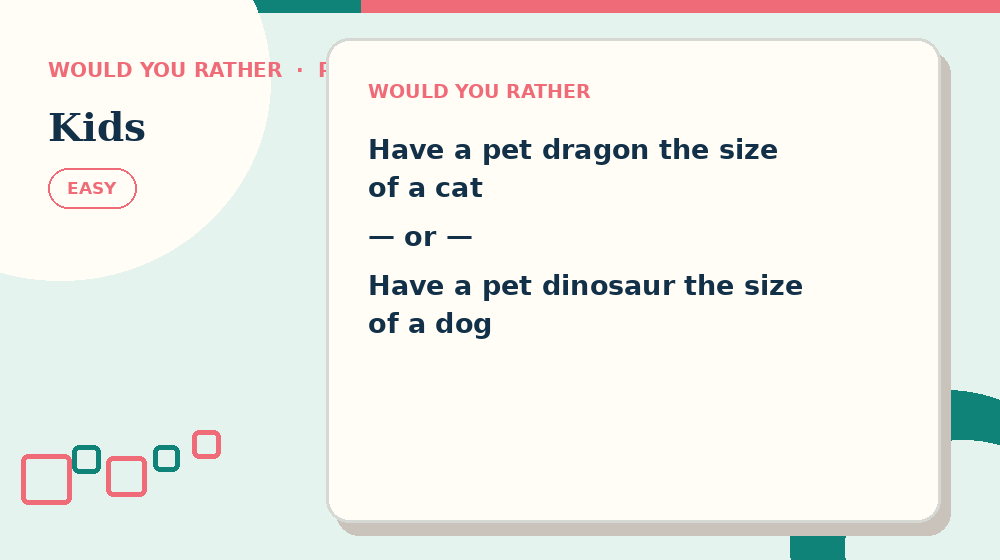
Use Would You Rather for Kids for the next pass. Try to give quiet thinking time without opening the answer material, then return here and name the evidence that supported the decision.
Step 3 — Invite each participant to choose, pass or say they are undecided. Collect choices before debate when possible. This protects quieter players from simply following the first confident answer.
Step 4 — Ask one neutral question such as ‘What matters most in that choice?’ or ‘What would you plan first?’ Avoid ‘Are you sure?’ because it implies that the facilitator doubts one side.
Step 5 — Reflect one or two reasons accurately and close the turn. Thank participants for distinct reasoning, not for choosing the popular option. Move to the next prompt before disagreement becomes repetitive or personal.
Worked example: a travel choice
Try this low-stakes prompt: would you rather spend a week exploring one city or visit three cities for two days each? Read both options, wait quietly and collect the initial choices. Both sides offer a real benefit, so neither needs a hidden penalty to create discussion.
Use one follow-up that works for either side: ‘What would you plan before leaving?’ A one-city player might talk about neighbourhoods or museums; a three-city player might talk about trains or packing lightly. The question develops the reason without asking for private travel history or a family budget.
If someone changes sides after hearing another plan, treat the change as thoughtful listening rather than inconsistency. Close by summarising the two planning priorities the group discovered. Do not announce a winning side or count the larger group as more sensible.
Facilitator notes that improve the next round
After the travel prompt, note whether both options received serious consideration, whether everyone had enough reading time and whether the follow-up produced new reasons. Do not record names beside preferences. The note is for improving the prompt set, not building a profile of participants.
Record any wording that required clarification. If ‘exploring’ was interpreted in several useful ways, keep it. If ‘visit’ caused confusion about travel days, edit the card before reuse. A good revision removes avoidable ambiguity without narrowing the imaginative part of the choice.
Notice who was interrupted or skipped by the turn order. Change the facilitation method on the next card—pair discussion, option cards or a clockwise round—rather than asking a quieter participant to compete harder for airtime.
Check whether the round is working
Could every participant repeat both options before choosing? If not, slow the reading, enlarge the card or simplify the wording. A choice made from half a prompt is not evidence that the game is quick; it is evidence that the interface or facilitation is too fast.
Did the follow-up invite reasons from both sides? Replace questions that challenge only one option. ‘Why would you do that?’ can sound accusatory, while ‘What appeals to you about that option?’ works symmetrically.
Did anyone disclose more than they intended because the room kept pressing? Re-state the pass rule immediately and retire the prompt. A successful round leaves participants willing to join the next one; a dramatic answer is not worth damaging that trust.
Adjust difficulty without changing the core skill
For an easier would you rather activity, reduce option familiarity, emotional stakes, reasoning depth, group size, discussion time and the option to pass while preserving the goal to move from a quick choice to a respectful explanation and shared discussion. Keep the same opening method: read both options without signaling a preferred answer.
For a harder how to play would you rather task, add one source of complexity at a time. Continue to require this evidence: the two stated options, the reason a participant gives and the discussion rule that keeps both choices acceptable. More decoration, smaller print or longer instructions do not create useful difficulty.
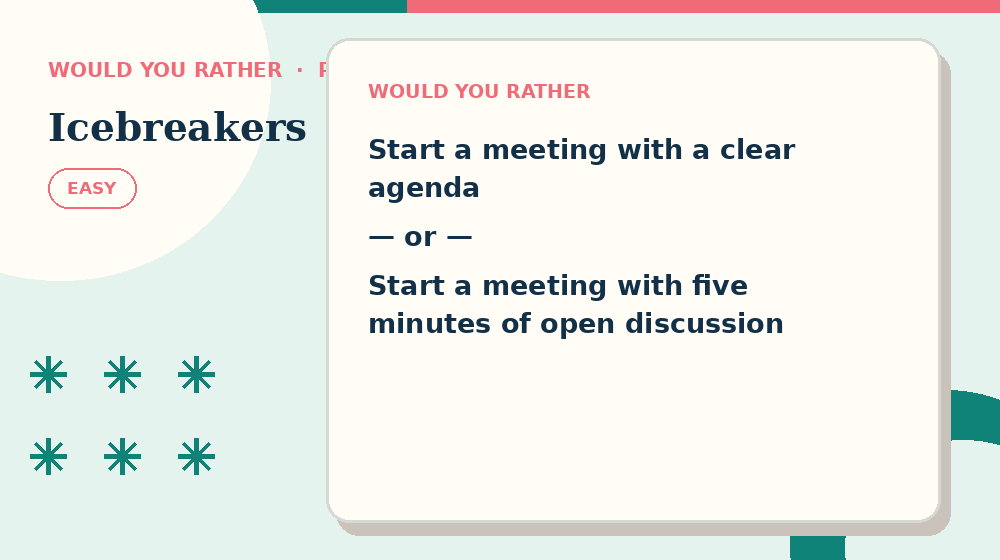
Now compare the method on Would You Rather Icebreaker. Keep the goal—move from a quick choice to a respectful explanation and shared discussion—but change only the difficulty or theme, so the comparison shows whether the routine transfers.
For families, classrooms, youth groups and team gatherings, adjust the amount of material, available time or input method before removing the reasoning step. Assistance should make the evidence reachable without supplying the result.
Common mistakes and precise recovery actions
Watch for this first failure in How to Play Would You Rather: using choices that embarrass players. Stop, restore one pair of options, one participant's choice and the reason they are comfortable sharing and repeat this action: read both options without signaling a preferred answer.
A second risk is arguing that one answer is correct. Compare the current work with the two stated options, the reason a participant gives and the discussion rule that keeps both choices acceptable; keep only decisions that the evidence supports.
If you notice letting the loudest person answer first every time, return to this method: ask each player to choose before debating. Record the corrected result before touching any later answer.
When requiring personal disclosure occurs, use this recovery procedure: pause the prompt, restate both options neutrally, offer a pass and restart the turn without scoring or challenging the participant's preference. Continue only when the progress measure changes for a stated reason.
Prevent the final failure - asking too many prompts without discussion - by completing this action: move on before the conversation becomes repetitive. Then run the verification for how to play would you rather: repeat the selected option and its reason without changing the participant's meaning or treating preference as correctness.
Build a checklist for How to Play Would You Rather
Write the How to Play Would You Rather goal first: move from a quick choice to a respectful explanation and shared discussion. Under it, copy this opening action: read both options without signaling a preferred answer. Leave space for the result, not merely a tick box.
Add the second and third checks in order: give quiet thinking time; then ask each player to choose before debating. Beside both, print the record rule: note optional follow-up ideas without scoring preferences as right or wrong.
Reserve a separate line for the hard-area pass: use one neutral follow-up question. Name the exact unit inspected so a later correction does not erase unrelated progress.
End the checklist with this action: move on before the conversation becomes repetitive. Follow it immediately with the verification statement: repeat the selected option and its reason without changing the participant's meaning or treating preference as correctness.
Test the checklist against the worked case - asking a travel choice, then inviting players to explain what they would pack or plan for their option. Rewrite any item that still needs the full article to explain what object to inspect or when to stop.
- Open with: read both options without signaling a preferred answer.
- Develop with: give quiet thinking time.
- Discriminate with: ask each player to choose before debating.
- Resolve with: use one neutral follow-up question.
- Close with: move on before the conversation becomes repetitive.
Use the game with different groups
In a classroom, connect the follow-up to a speaking objective: give one reason, compare two consequences or respond respectfully to a different choice. Keep preference separate from academic correctness. Assess the communication skill only if that expectation was explained before play.
At home, let children write or select some reviewed prompts, but adults should remove questions that target siblings, punishments or family resources. Family humour works best when nobody becomes the subject of the card.
If the step in “Use the game with different groups” is still unclear, continue with How to Write Good Would You Rather Questions. It approaches the same puzzle format from a different decision point before you need to reveal an answer.
For a team gathering, begin with practical, low-stakes choices and avoid prompts that imitate hiring, performance review or workplace loyalty tests. A facilitator should be able to explain why each prompt is safe for colleagues with different roles and backgrounds.
A focused 15-minute practice routine
Minutes 0-3 for How to Play Would You Rather: prepare a reviewed prompt set, a turn order and permission to pass on any question. State the goal to move from a quick choice to a respectful explanation and shared discussion, then identify the first one pair of options, one participant's choice and the reason they are comfortable sharing you will inspect.
Minutes 3-7 for how to play would you rather: complete read both options without signaling a preferred answer, followed by give quiet thinking time. Record both outcomes using this rule: note optional follow-up ideas without scoring preferences as right or wrong.
Minutes 7-12: complete this action on the least certain result: ask each player to choose before debating. If the evidence supports a next move, continue with use one neutral follow-up question; otherwise keep the uncertainty visible.
Minutes 12-15: complete move on before the conversation becomes repetitive. End the would you rather practice by checking that repeat the selected option and its reason without changing the participant's meaning or treating preference as correctness, even when the full page remains unfinished.
Print, screen and accessibility choices
To print How to Play Would You Rather, follow this format rule: cut prompt cards so both choices remain on the same card and remove unsuitable prompts beforehand. Test one page at actual size and inspect the working area before producing a batch.
To use how to play would you rather online, follow this screen rule: show both options together, allow a pass and move to the next prompt without exposing private input. Verify keyboard, touch and mouse behaviour at the zoom level the player needs.
Accessibility support for families, classrooms, youth groups and team gatherings should preserve the evidence - the two stated options, the reason a participant gives and the discussion rule that keeps both choices acceptable - while changing size, contrast, input method or session length. Support access without silently supplying the answer.
How to know the method is working
For How to Play Would You Rather, use this progress measure: track balanced participation and completed discussions rather than agreement between players. Improvement should appear as smaller corrections and explanations that refer to the two stated options, the reason a participant gives and the discussion rule that keeps both choices acceptable.
Repeat a nearby how to play would you rather activity within two days. Without reopening the guide, look for independent use of these actions: read both options without signaling a preferred answer; and ask each player to choose before debating.
Keep a short private note containing the page, difficulty, first error and verification result. Use it to select the next activity; do not turn it into a judgement about families, classrooms, youth groups and team gatherings.
Test the skill on a fresh puzzle
Open one linked would you rather page and write down two actions before starting: read both options without signaling a preferred answer, followed by give quiet thinking time. Put How to Play Would You Rather aside during the attempt.
At the first uncertain point, use this method without prompting: ask each player to choose before debating. Compare one confirmed result with one unresolved result and name the evidence separating them.
Complete the fresh attempt by doing this: move on before the conversation becomes repetitive. Run the same final check - repeat the selected option and its reason without changing the participant's meaning or treating preference as correctness - and record one specific adjustment for the next page.
Frequently asked questions
What should I do first in How to Play Would You Rather?
Begin with the catalogued opening action for how to play would you rather: read both options without signaling a preferred answer. Apply it to one pair of options, one participant's choice and the reason they are comfortable sharing and record the result before moving to give quiet thinking time.
How can I tell whether my how to play would you rather method is producing real progress?
For this would you rather task, use the progress test 'track balanced participation and completed discussions rather than agreement between players'. A new mark counts only when it can be connected to the two stated options, the reason a participant gives and the discussion rule that keeps both choices acceptable.
What should I do if I notice using choices that embarrass players?
Stop at the first affected unit and use the format-specific recovery: pause the prompt, restate both options neutrally, offer a pass and restart the turn without scoring or challenging the participant's preference. Resume How to Play Would You Rather with ask each player to choose before debating instead of repeating the unsupported move.
When is it appropriate to check the answer for How to Play Would You Rather?
Check after completing this final action: move on before the conversation becomes repetitive. Before opening the answer, write the exact unresolved point and test whether repeat the selected option and its reason without changing the participant's meaning or treating preference as correctness.
How can I make this would you rather practice more accessible?
Change size, spacing, session length or input method while preserving the two stated options, the reason a participant gives and the discussion rule that keeps both choices acceptable. On paper, cut prompt cards so both choices remain on the same card and remove unsuitable prompts beforehand. On screen, show both options together, allow a pass and move to the next prompt without exposing private input.
What should I practise after How to Play Would You Rather?
Choose a nearby how to play would you rather page and repeat two actions without reopening the article: read both options without signaling a preferred answer; then ask each player to choose before debating. Finish by checking that repeat the selected option and its reason without changing the participant's meaning or treating preference as correctness.