Use this guide as a working method, not a list of tricks. Read one section, apply it to a real activity, and keep the evidence that shows why each move works.
The short answer
A strong Would You Rather question presents two clear options that are comparably attractive, inconvenient or interesting. The reader should understand the choice in one pass and be able to imagine a reason for either side. The writer's job is to balance the decision, not hide a correct answer.
Draft the two options in parallel language, remove accidental loopholes and test the prompt on someone who did not help write it. Ask which side they considered and why. If they dismiss one option immediately because of wording rather than preference, revise the weaker side.
Before continuing, open Would You Rather and practise this first move: choose one audience and one conversation goal before drafting, because a good classroom warm-up, family question and adult party prompt do not use the same risk level or subject matter. The complete activity makes the setup advice above easier to judge than an isolated example.
Write for a named audience and setting. A classroom icebreaker, a family dinner card and an adults-only party set need different boundaries. Topic safety, reading level and permission to pass belong in the editorial brief before ideas are generated.
Understand the exact job of this activity
In How to Write Good Would You Rather Questions, success means you can build two clear options that compete on a meaningful trade-off, feel comparably attractive or costly for the intended audience and give players something worth explaining after they choose. The relevant evidence is the two stated options, the reason a participant gives and the discussion rule that keeps both choices acceptable. Decoration, familiarity with the theme and confidence are not evidence by themselves.
Use one pair of options, one participant's choice and the reason they are comfortable sharing to keep the decision local. Start by doing this: choose one audience and one conversation goal before drafting, because a good classroom warm-up, family question and adult party prompt do not use the same risk level or subject matter. If you cannot name what changed, do not add another permanent answer or mark.
Measure progress by this standard: track balanced participation and completed discussions rather than agreement between players. When progress stops, return to this method: make the two options parallel in grammar, scope and consequence, removing hidden advantages that make one side obviously superior before the player has considered the dilemma. State the reason for changing approach before you make the next move.
Prepare the materials and the decision record
For How to Write Good Would You Rather Questions, lay out one audience and setting, a list of safe themes that fit that group, paired option ideas and at least one fresh test player who can answer without needing extra rules or clarification. Keep any answer material closed or out of reach until the attempt has a complete result or a precisely stated question.
On paper, cut prompt cards so both choices remain on the same card and remove unsuitable prompts beforehand. On screen, show both options together, allow a pass and move to the next prompt without exposing private input. Check the real input method before starting so a print, zoom or touch problem is not mistaken for puzzle difficulty.
Record uncertain work this way: note optional follow-up ideas without scoring preferences as right or wrong. If teachers, parents, party hosts, team facilitators and anyone creating conversation games pause and return later, the record should show what is confirmed, what is provisional and what was rejected.
- Goal: build two clear options that compete on a meaningful trade-off, feel comparably attractive or costly for the intended audience and give players something worth explaining after they choose.
- First action: choose one audience and one conversation goal before drafting, because a good classroom warm-up, family question and adult party prompt do not use the same risk level or subject matter.
- Working unit: one pair of options, one participant's choice and the reason they are comfortable sharing.
- Final check: repeat the selected option and its reason without changing the participant's meaning or treating preference as correctness.
Write and edit one prompt
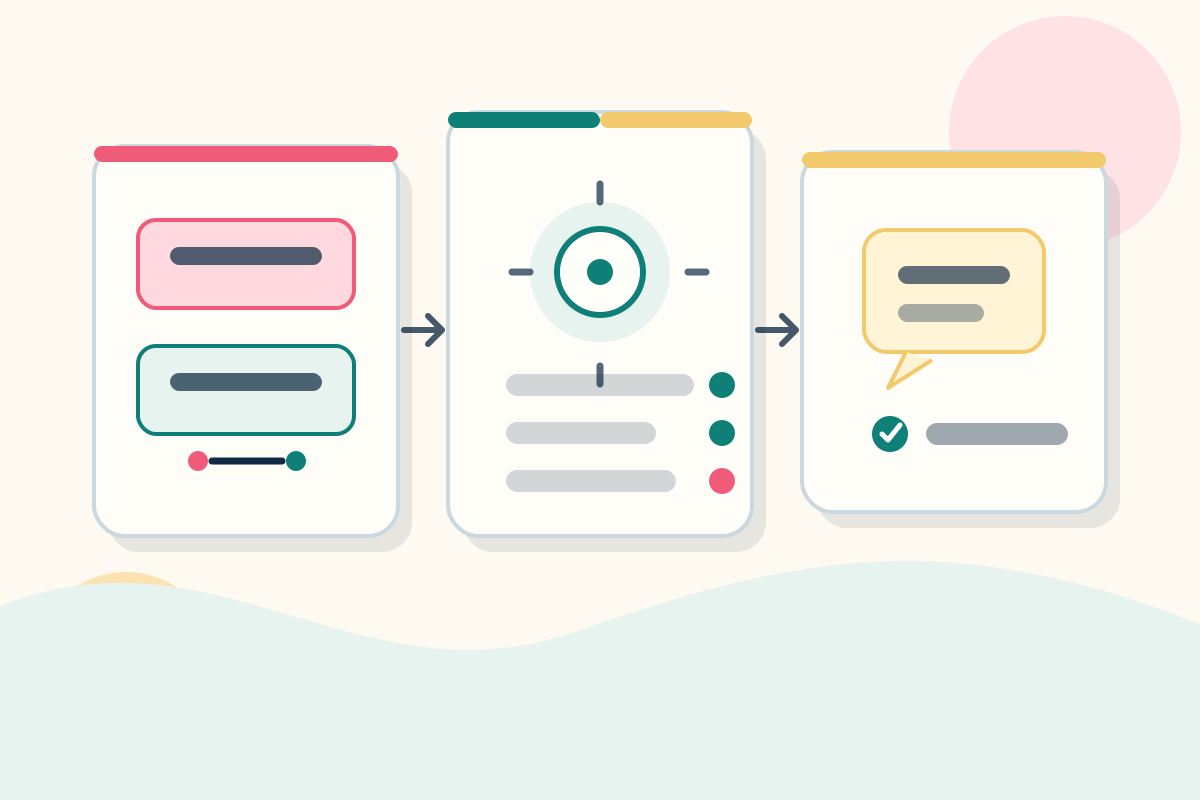
Step 1 — Choose one decision axis: speed versus comfort, variety versus depth, certainty versus surprise, or convenience versus experience. Both options should sit on that same axis. Combining unrelated benefits makes comparison muddy.
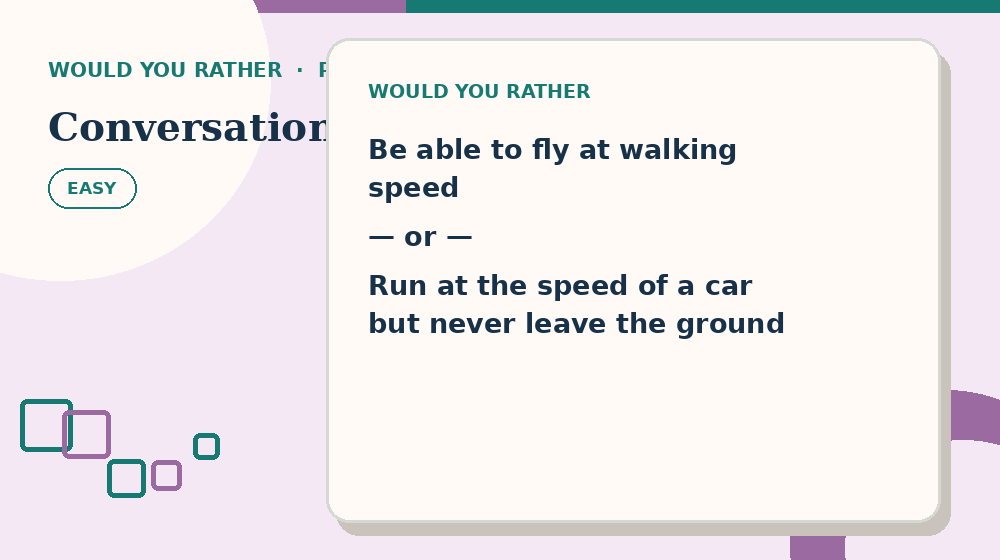
Step 2 — Draft both options with matching grammar and similar detail. ‘Live beside the sea’ and ‘a cabin in snowy mountains’ should become ‘live beside the sea’ or ‘live in a cabin in snowy mountains.’ Parallel wording lets the decision, not the sentence shape, carry the contrast.
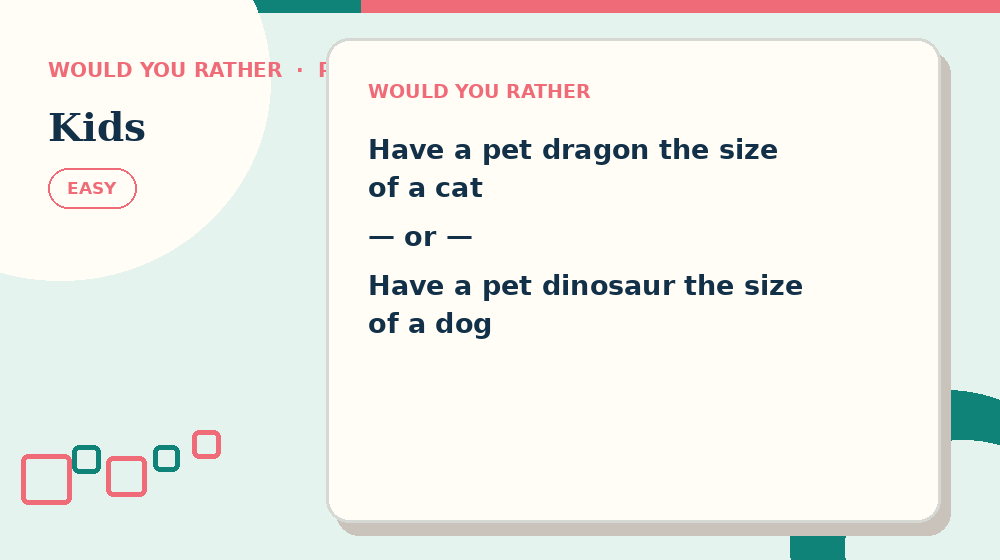
Use Would You Rather for Kids for the next pass. Try to build both options around one shared trade-off such as time versus money, certainty versus freedom, comfort versus adventure or convenience versus experience so the choice has a real tension without opening the answer material, then return here and name the evidence that supported the decision.
Step 3 — State only conditions that materially affect the choice. Check duration, frequency, reversibility and hidden costs. If one option lasts forever and the other lasts a day, the duration difference will dominate every discussion unless that is the intended axis.
Step 4 — Run the safety and loophole edit. Remove a secret third option, an easy workaround and any requirement to reveal sensitive experience. Add permission to pass at the game level instead of repeating it awkwardly on every card.
Step 5 — Test the prompt aloud. Ask a fresh reader to paraphrase both sides, choose provisionally and suggest one reason for the rejected side. Revise whenever the rejected option has no plausible supporter.
Worked example: revising a travel prompt
Start with a weak draft: ‘Would you rather travel slowly in a beautiful city or rush through three boring cities?’ The adjectives decide the answer before the participant does. Remove the judgement and put both options on the same time-versus-variety axis.
A balanced revision is: ‘Would you rather spend a week exploring one city or visit three cities for two days each?’ Duration and number of places are clear enough to imagine, and both options offer a recognisable advantage.
Test follow-up potential with symmetrical questions: ‘What would you plan first?’ and ‘What might you miss about the other option?’ If both questions work for either side, the prompt is likely to support discussion rather than a one-word vote.
Keep an editing record
Record the original wording, the problem found and the reason for the revision. For the travel example, the problem is loaded adjectives; the edit removes ‘beautiful’ and ‘boring.’ This note is more useful than marking the draft simply bad.
Log the conditions that remain: one week in one city versus two days in each of three cities. A future editor can now see that time and variety are intentional, not accidental inconsistencies.
Add test-reader observations without storing personal preferences. Note whether both sides attracted reasons, whether any term needed explanation and which follow-up produced useful comparison. Use those observations to revise the card, not to rank the reader.
Diagnostic questions for How to Write Good Would You Rather Questions
Can you explain why choose one audience and one conversation goal before drafting, because a good classroom warm-up, family question and adult party prompt do not use the same risk level or subject matter is the correct opening for how to write would you rather questions? If not, restate the goal - build two clear options that compete on a meaningful trade-off, feel comparably attractive or costly for the intended audience and give players something worth explaining after they choose - before making another mark.
Does the current record follow this rule: note optional follow-up ideas without scoring preferences as right or wrong? If not, separate confirmed work from possibilities before the next method.
Which evidence supports the current decision: the two stated options, the reason a participant gives and the discussion rule that keeps both choices acceptable? Remove any answer supported only by familiarity or appearance.
Have you checked for this specific failure: combining unrelated scenarios whose differences are too broad to create one understandable trade-off? Repair that issue locally instead of restarting unrelated work.
Can the final result pass this test: repeat the selected option and its reason without changing the participant's meaning or treating preference as correctness? If not, leave the activity marked as unfinished and record the exact failing unit.
Adjust difficulty without changing the core skill
For an easier would you rather activity, reduce option familiarity, emotional stakes, reasoning depth, group size, discussion time and the option to pass while preserving the goal to build two clear options that compete on a meaningful trade-off, feel comparably attractive or costly for the intended audience and give players something worth explaining after they choose. Keep the same opening method: choose one audience and one conversation goal before drafting, because a good classroom warm-up, family question and adult party prompt do not use the same risk level or subject matter.
For a harder how to write would you rather questions task, add one source of complexity at a time. Continue to require this evidence: the two stated options, the reason a participant gives and the discussion rule that keeps both choices acceptable. More decoration, smaller print or longer instructions do not create useful difficulty.
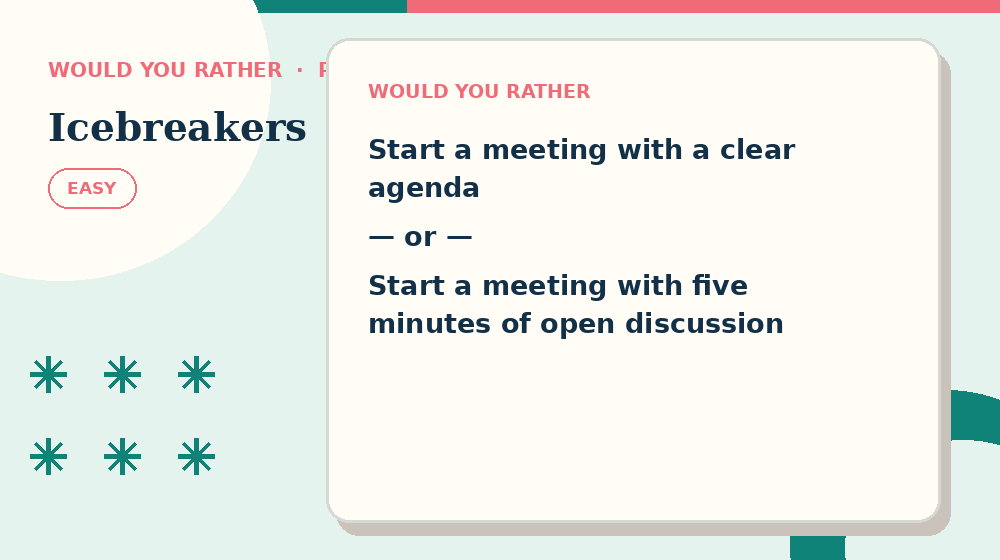
Now compare the method on Would You Rather Icebreaker. Keep the goal—build two clear options that compete on a meaningful trade-off, feel comparably attractive or costly for the intended audience and give players something worth explaining after they choose—but change only the difficulty or theme, so the comparison shows whether the routine transfers.
For teachers, parents, party hosts, team facilitators and anyone creating conversation games, adjust the amount of material, available time or input method before removing the reasoning step. Assistance should make the evidence reachable without supplying the result.
Common mistakes and precise recovery actions
Watch for this first failure in How to Write Good Would You Rather Questions: pairing a valuable option with a trivial option so nearly everyone chooses the same side. Stop, restore one pair of options, one participant's choice and the reason they are comfortable sharing and repeat this action: choose one audience and one conversation goal before drafting, because a good classroom warm-up, family question and adult party prompt do not use the same risk level or subject matter.
A second risk is combining unrelated scenarios whose differences are too broad to create one understandable trade-off. Compare the current work with the two stated options, the reason a participant gives and the discussion rule that keeps both choices acceptable; keep only decisions that the evidence supports.
If you notice adding so many conditions that players spend more time interpreting the question than choosing, return to this method: make the two options parallel in grammar, scope and consequence, removing hidden advantages that make one side obviously superior before the player has considered the dilemma. Record the corrected result before touching any later answer.
When using personal, embarrassing or high-stakes topics without checking that they are appropriate for the audience and setting occurs, use this recovery procedure: pause the prompt, restate both options neutrally, offer a pass and restart the turn without scoring or challenging the participant's preference. Continue only when the progress measure changes for a stated reason.
Prevent the final failure - stopping after the vote instead of giving players a useful follow-up that turns the forced choice into conversation - by completing this action: test the question with a fresh player or small group and revise prompts that produce instant unanimous answers, confusion, discomfort or repeated requests for exceptions. Then run the verification for how to write would you rather questions: repeat the selected option and its reason without changing the participant's meaning or treating preference as correctness.
Build a checklist for How to Write Good Would You Rather Questions
Write the How to Write Good Would You Rather Questions goal first: build two clear options that compete on a meaningful trade-off, feel comparably attractive or costly for the intended audience and give players something worth explaining after they choose. Under it, copy this opening action: choose one audience and one conversation goal before drafting, because a good classroom warm-up, family question and adult party prompt do not use the same risk level or subject matter. Leave space for the result, not merely a tick box.
Add the second and third checks in order: build both options around one shared trade-off such as time versus money, certainty versus freedom, comfort versus adventure or convenience versus experience so the choice has a real tension; then make the two options parallel in grammar, scope and consequence, removing hidden advantages that make one side obviously superior before the player has considered the dilemma. Beside both, print the record rule: note optional follow-up ideas without scoring preferences as right or wrong.
Reserve a separate line for the hard-area pass: add one short follow-up that asks why, what would change the decision or which consequence matters most, because the explanation is usually more engaging than the vote itself. Name the exact unit inspected so a later correction does not erase unrelated progress.
End the checklist with this action: test the question with a fresh player or small group and revise prompts that produce instant unanimous answers, confusion, discomfort or repeated requests for exceptions. Follow it immediately with the verification statement: repeat the selected option and its reason without changing the participant's meaning or treating preference as correctness.
Test the checklist against the worked case - rewriting a weak choice such as one million dollars versus one ordinary paperclip into a balanced trade-off such as unlimited free time with a tight budget versus plenty of money with very little free time, then asking which resource the player values more. Rewrite any item that still needs the full article to explain what object to inspect or when to stop.
- Open with: choose one audience and one conversation goal before drafting, because a good classroom warm-up, family question and adult party prompt do not use the same risk level or subject matter.
- Develop with: build both options around one shared trade-off such as time versus money, certainty versus freedom, comfort versus adventure or convenience versus experience so the choice has a real tension.
- Discriminate with: make the two options parallel in grammar, scope and consequence, removing hidden advantages that make one side obviously superior before the player has considered the dilemma.
- Resolve with: add one short follow-up that asks why, what would change the decision or which consequence matters most, because the explanation is usually more engaging than the vote itself.
- Close with: test the question with a fresh player or small group and revise prompts that produce instant unanimous answers, confusion, discomfort or repeated requests for exceptions.
Test prompts with the intended audience
Ask test readers to paraphrase the question before choosing. Misparaphrase reveals a wording problem more reliably than asking whether the card is clear. Revise the source and test again with someone who has not seen the explanation.
In a classroom, check vocabulary and cultural assumptions as carefully as topic safety. A prompt about unfamiliar travel, food or technology may assess background knowledge instead of comparison skills.
If the step in “Test prompts with the intended audience” is still unclear, continue with How to Play Would You Rather. It approaches the same puzzle format from a different decision point before you need to reveal an answer.
For family or community sets, invite reviewers to flag cards they would prefer to pass without requiring a reason. A high pass rate is editorial evidence that the topic or wording does not fit that audience.
A focused 15-minute practice routine
Minutes 0-3 for How to Write Good Would You Rather Questions: prepare one audience and setting, a list of safe themes that fit that group, paired option ideas and at least one fresh test player who can answer without needing extra rules or clarification. State the goal to build two clear options that compete on a meaningful trade-off, feel comparably attractive or costly for the intended audience and give players something worth explaining after they choose, then identify the first one pair of options, one participant's choice and the reason they are comfortable sharing you will inspect.
Minutes 3-7 for how to write would you rather questions: complete choose one audience and one conversation goal before drafting, because a good classroom warm-up, family question and adult party prompt do not use the same risk level or subject matter, followed by build both options around one shared trade-off such as time versus money, certainty versus freedom, comfort versus adventure or convenience versus experience so the choice has a real tension. Record both outcomes using this rule: note optional follow-up ideas without scoring preferences as right or wrong.
Minutes 7-12: complete this action on the least certain result: make the two options parallel in grammar, scope and consequence, removing hidden advantages that make one side obviously superior before the player has considered the dilemma. If the evidence supports a next move, continue with add one short follow-up that asks why, what would change the decision or which consequence matters most, because the explanation is usually more engaging than the vote itself; otherwise keep the uncertainty visible.
Minutes 12-15: complete test the question with a fresh player or small group and revise prompts that produce instant unanimous answers, confusion, discomfort or repeated requests for exceptions. End the would you rather practice by checking that repeat the selected option and its reason without changing the participant's meaning or treating preference as correctness, even when the full page remains unfinished.
Print, screen and accessibility choices
To print How to Write Good Would You Rather Questions, follow this format rule: cut prompt cards so both choices remain on the same card and remove unsuitable prompts beforehand. Test one page at actual size and inspect the working area before producing a batch.
To use how to write would you rather questions online, follow this screen rule: show both options together, allow a pass and move to the next prompt without exposing private input. Verify keyboard, touch and mouse behaviour at the zoom level the player needs.
Accessibility support for teachers, parents, party hosts, team facilitators and anyone creating conversation games should preserve the evidence - the two stated options, the reason a participant gives and the discussion rule that keeps both choices acceptable - while changing size, contrast, input method or session length. Support access without silently supplying the answer.
How to know the method is working
For How to Write Good Would You Rather Questions, use this progress measure: track balanced participation and completed discussions rather than agreement between players. Improvement should appear as smaller corrections and explanations that refer to the two stated options, the reason a participant gives and the discussion rule that keeps both choices acceptable.
Repeat a nearby how to write would you rather questions activity within two days. Without reopening the guide, look for independent use of these actions: choose one audience and one conversation goal before drafting, because a good classroom warm-up, family question and adult party prompt do not use the same risk level or subject matter; and make the two options parallel in grammar, scope and consequence, removing hidden advantages that make one side obviously superior before the player has considered the dilemma.
Keep a short private note containing the page, difficulty, first error and verification result. Use it to select the next activity; do not turn it into a judgement about teachers, parents, party hosts, team facilitators and anyone creating conversation games.
Test the skill on a fresh puzzle
Open one linked would you rather page and write down two actions before starting: choose one audience and one conversation goal before drafting, because a good classroom warm-up, family question and adult party prompt do not use the same risk level or subject matter, followed by build both options around one shared trade-off such as time versus money, certainty versus freedom, comfort versus adventure or convenience versus experience so the choice has a real tension. Put How to Write Good Would You Rather Questions aside during the attempt.
At the first uncertain point, use this method without prompting: make the two options parallel in grammar, scope and consequence, removing hidden advantages that make one side obviously superior before the player has considered the dilemma. Compare one confirmed result with one unresolved result and name the evidence separating them.
Complete the fresh attempt by doing this: test the question with a fresh player or small group and revise prompts that produce instant unanimous answers, confusion, discomfort or repeated requests for exceptions. Run the same final check - repeat the selected option and its reason without changing the participant's meaning or treating preference as correctness - and record one specific adjustment for the next page.
Frequently asked questions
What should I do first in How to Write Good Would You Rather Questions?
Begin with the catalogued opening action for how to write would you rather questions: choose one audience and one conversation goal before drafting, because a good classroom warm-up, family question and adult party prompt do not use the same risk level or subject matter. Apply it to one pair of options, one participant's choice and the reason they are comfortable sharing and record the result before moving to build both options around one shared trade-off such as time versus money, certainty versus freedom, comfort versus adventure or convenience versus experience so the choice has a real tension.
How can I tell whether my how to write would you rather questions method is producing real progress?
For this would you rather task, use the progress test 'track balanced participation and completed discussions rather than agreement between players'. A new mark counts only when it can be connected to the two stated options, the reason a participant gives and the discussion rule that keeps both choices acceptable.
What should I do if I notice pairing a valuable option with a trivial option so nearly everyone chooses the same side?
Stop at the first affected unit and use the format-specific recovery: pause the prompt, restate both options neutrally, offer a pass and restart the turn without scoring or challenging the participant's preference. Resume How to Write Good Would You Rather Questions with make the two options parallel in grammar, scope and consequence, removing hidden advantages that make one side obviously superior before the player has considered the dilemma instead of repeating the unsupported move.
When is it appropriate to check the answer for How to Write Good Would You Rather Questions?
Check after completing this final action: test the question with a fresh player or small group and revise prompts that produce instant unanimous answers, confusion, discomfort or repeated requests for exceptions. Before opening the answer, write the exact unresolved point and test whether repeat the selected option and its reason without changing the participant's meaning or treating preference as correctness.
How can I make this would you rather practice more accessible?
Change size, spacing, session length or input method while preserving the two stated options, the reason a participant gives and the discussion rule that keeps both choices acceptable. On paper, cut prompt cards so both choices remain on the same card and remove unsuitable prompts beforehand. On screen, show both options together, allow a pass and move to the next prompt without exposing private input.
What should I practise after How to Write Good Would You Rather Questions?
Choose a nearby how to write would you rather questions page and repeat two actions without reopening the article: choose one audience and one conversation goal before drafting, because a good classroom warm-up, family question and adult party prompt do not use the same risk level or subject matter; then make the two options parallel in grammar, scope and consequence, removing hidden advantages that make one side obviously superior before the player has considered the dilemma. Finish by checking that repeat the selected option and its reason without changing the participant's meaning or treating preference as correctness.