Use this guide as a working method, not a list of tricks. Read one section, apply it to a real activity, and keep the evidence that shows why each move works.
The short answer
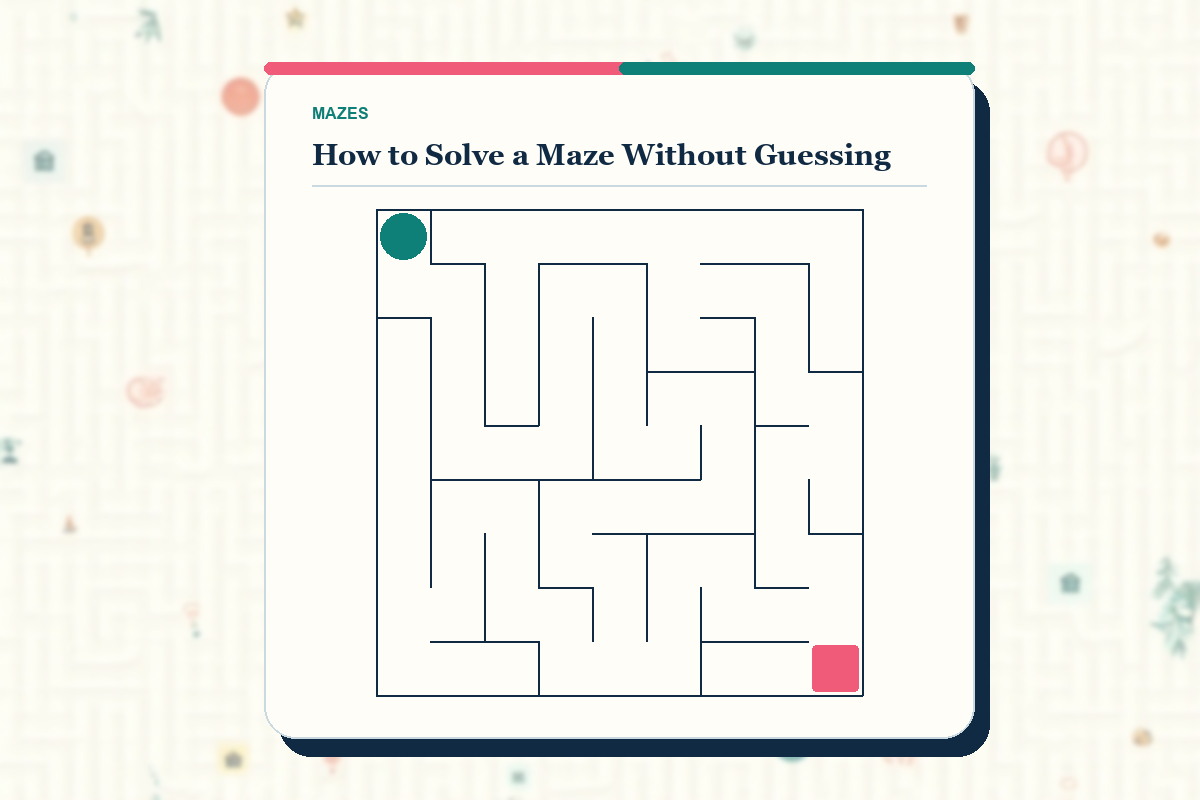
Find the entrance and exit, preview major blocked regions and choose one route-tracking method before drawing. At each junction, record which branch you test and return to that junction when the branch closes.
Wall following works when you consistently keep one hand against the same connected wall. Junction tracking works by numbering or marking decision points. Switching methods without recording the change creates repeated branches.
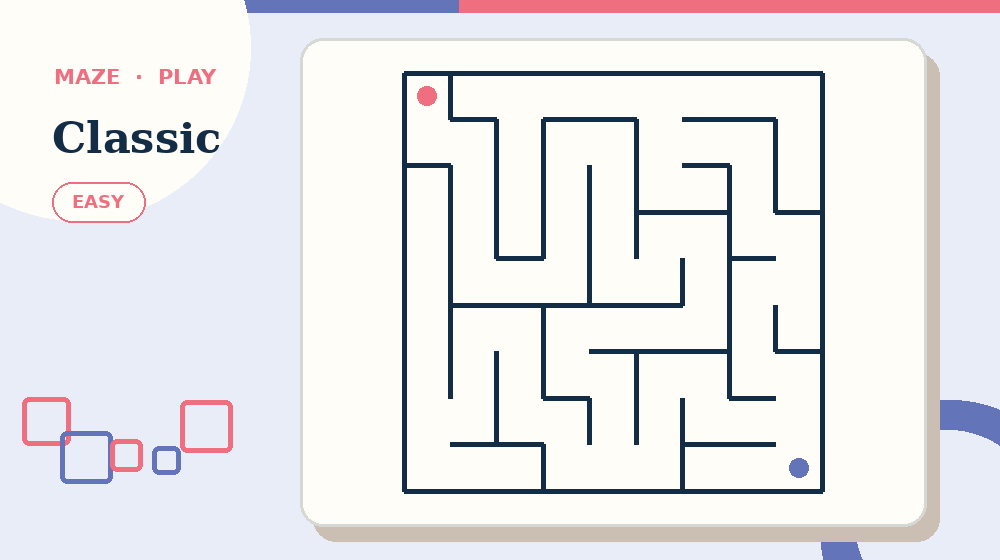
Before continuing, open Easy Maze and practise this first move: preview the start, finish and large blocked regions. The complete activity makes the setup advice above easier to judge than an isolated example.
After reaching the exit, retrace the route from start to finish in one clean pass. A valid solution must remain inside every wall and connect both endpoints without a hidden jump.
Understand the exact job of this activity
In How to Solve a Maze Without Guessing, success means you can treat the maze as connected decisions rather than a picture to wander through. The relevant evidence is open passages, closed walls, junctions already tested and a continuous route from the entrance toward the goal. Decoration, familiarity with the theme and confidence are not evidence by themselves.
Use one junction, the branches leaving it and the last confirmed open passage to keep the decision local. Start by doing this: preview the start, finish and large blocked regions. If you cannot name what changed, do not add another permanent answer or mark.
Measure progress by this standard: count resolved junctions and eliminated dead ends, not distance from the finish in a straight line. When progress stops, return to this method: mark each dead end when you return from it. State the reason for changing approach before you make the next move.
Prepare the materials and the decision record
For How to Solve a Maze Without Guessing, lay out a visible start and finish, a traceable route and a way to mark explored dead ends. Keep any answer material closed or out of reach until the attempt has a complete result or a precisely stated question.
On paper, preview with a finger, then trace with a pencil fine enough to leave every wall visible. On screen, move one cell or junction at a time and use undo instead of jumping across passages. Check the real input method before starting so a print, zoom or touch problem is not mistaken for puzzle difficulty.
Record uncertain work this way: mark a tested dead end lightly and keep the successful route thinner than the maze walls. If children, adults and anyone who gets lost in dense mazes pause and return later, the record should show what is confirmed, what is provisional and what was rejected.
- Goal: treat the maze as connected decisions rather than a picture to wander through.
- First action: preview the start, finish and large blocked regions.
- Working unit: one junction, the branches leaving it and the last confirmed open passage.
- Final check: trace the chosen route continuously from start to finish and stop at every turn to confirm no wall is crossed.
Solve one route systematically
Step 1 - Preview from both endpoints and locate the first junction from the entrance. Do not draw through distant passages during preview.
Step 2 - Select one branch and record the junction. Look ahead only until the next decision or closure.
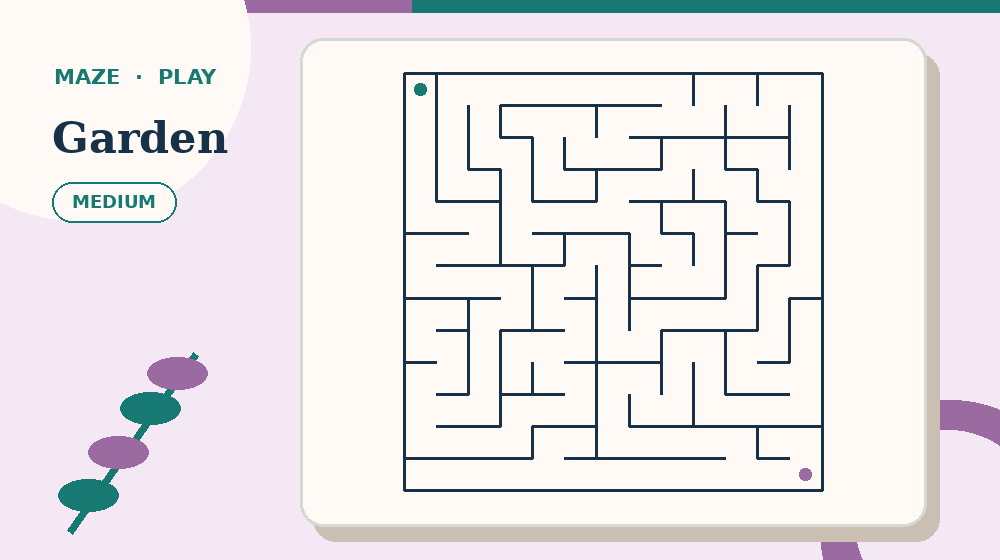
Use Garden Maze for the next pass. Try to choose either wall following or junction tracking without opening the answer material, then return here and name the evidence that supported the decision.
Step 3 - At a dead end, return along the same corridor and mark that branch as tested. Resume from the recorded junction rather than from memory.
Step 4 - Continue without changing tracking method. If a loop returns to a known junction, mark the connecting branch and choose an untested exit.
Step 5 - On reaching the destination, retrace the complete route and inspect every close wall crossing at high zoom or on the printed proof.
Worked example: a garden maze
In a garden maze, number the first three forks J1, J2 and J3. From J1, take the upper branch and follow it until it returns to J2 or ends.
If the branch closes, trace back to J1 and place a small slash beside the tested opening. Choose the lower branch without erasing the evidence.
Continue until the flower exit is reached, then draw a clean route on a fresh copy or retrace lightly. Check that every numbered junction uses the branch recorded as successful.
Decision log for the worked example
For the How to Solve a Maze Without Guessing example, log the first observation created by this action: preview the start, finish and large blocked regions. Write the observation itself, not a vague note that the step was completed.
Next, record what changed after you mark each dead end when you return from it. If nothing changed, keep that result; an explicit no-change result prevents the same unproductive pass from being repeated.
Close the log with the final check: trace the chosen route continuously from start to finish and stop at every turn to confirm no wall is crossed. If the check fails, identify the earliest unsupported decision and connect it to one risk: changing strategies halfway through.
Diagnostic questions for How to Solve a Maze Without Guessing
Can you explain why preview the start, finish and large blocked regions is the correct opening for how to solve a maze? If not, restate the goal - treat the maze as connected decisions rather than a picture to wander through - before making another mark.
Does the current record follow this rule: mark a tested dead end lightly and keep the successful route thinner than the maze walls? If not, separate confirmed work from possibilities before the next method.
Which evidence supports the current decision: open passages, closed walls, junctions already tested and a continuous route from the entrance toward the goal? Remove any answer supported only by familiarity or appearance.
Have you checked for this specific failure: drawing a thick line that hides walls? Repair that issue locally instead of restarting unrelated work.
Can the final result pass this test: trace the chosen route continuously from start to finish and stop at every turn to confirm no wall is crossed? If not, leave the activity marked as unfinished and record the exact failing unit.
Adjust difficulty without changing the core skill
For an easier mazes activity, reduce maze dimensions, branch count, dead-end depth, route length, line weight and the visibility of start and finish while preserving the goal to treat the maze as connected decisions rather than a picture to wander through. Keep the same opening method: preview the start, finish and large blocked regions.
For a harder how to solve a maze task, add one source of complexity at a time. Continue to require this evidence: open passages, closed walls, junctions already tested and a continuous route from the entrance toward the goal. More decoration, smaller print or longer instructions do not create useful difficulty.
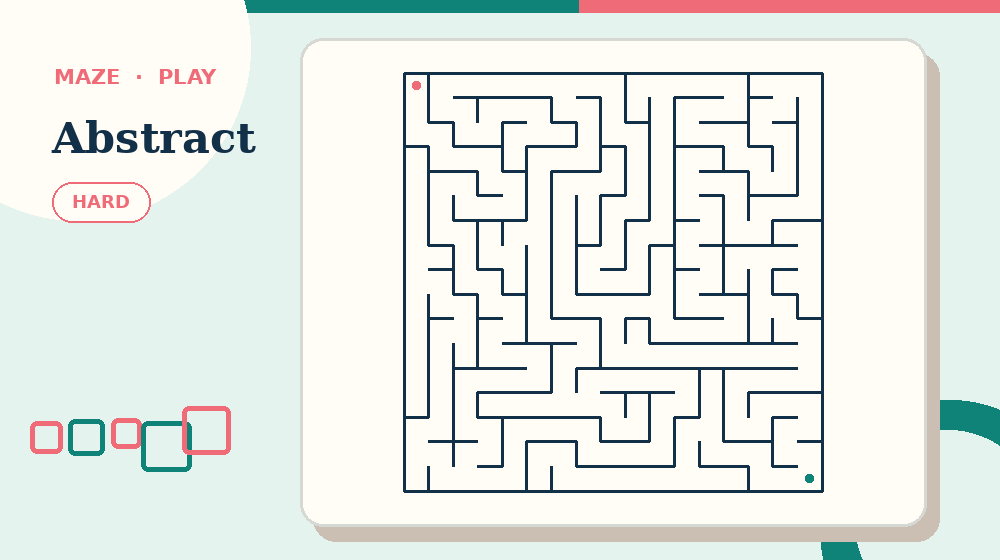
Now compare the method on Hard Maze. Keep the goal—treat the maze as connected decisions rather than a picture to wander through—but change only the difficulty or theme, so the comparison shows whether the routine transfers.
For children, adults and anyone who gets lost in dense mazes, adjust the amount of material, available time or input method before removing the reasoning step. Assistance should make the evidence reachable without supplying the result.
Common mistakes and precise recovery actions
Watch for this first failure in How to Solve a Maze Without Guessing: changing strategies halfway through. Stop, restore one junction, the branches leaving it and the last confirmed open passage and repeat this action: preview the start, finish and large blocked regions.
A second risk is drawing a thick line that hides walls. Compare the current work with open passages, closed walls, junctions already tested and a continuous route from the entrance toward the goal; keep only decisions that the evidence supports.
If you notice skipping over a narrow wall, return to this method: mark each dead end when you return from it. Record the corrected result before touching any later answer.
When forgetting which branch was tested occurs, use this recovery procedure: erase the route back to the last confirmed junction, mark the failed branch and choose only among the branches not yet tested. Continue only when the progress measure changes for a stated reason.
Prevent the final failure - assuming the path nearest the finish must connect - by completing this action: verify the route from start to finish after solving. Then run the verification for how to solve a maze: trace the chosen route continuously from start to finish and stop at every turn to confirm no wall is crossed.
Build a checklist for How to Solve a Maze Without Guessing
Write the How to Solve a Maze Without Guessing goal first: treat the maze as connected decisions rather than a picture to wander through. Under it, copy this opening action: preview the start, finish and large blocked regions. Leave space for the result, not merely a tick box.
Add the second and third checks in order: choose either wall following or junction tracking; then mark each dead end when you return from it. Beside both, print the record rule: mark a tested dead end lightly and keep the successful route thinner than the maze walls.
Reserve a separate line for the hard-area pass: look ahead to the next junction before moving. Name the exact unit inspected so a later correction does not erase unrelated progress.
End the checklist with this action: verify the route from start to finish after solving. Follow it immediately with the verification statement: trace the chosen route continuously from start to finish and stop at every turn to confirm no wall is crossed.
Test the checklist against the worked case - solving a garden maze by numbering three early junctions and crossing out each branch only after it returns to a dead end. Rewrite any item that still needs the full article to explain what object to inspect or when to stop.
- Open with: preview the start, finish and large blocked regions.
- Develop with: choose either wall following or junction tracking.
- Discriminate with: mark each dead end when you return from it.
- Resolve with: look ahead to the next junction before moving.
- Close with: verify the route from start to finish after solving.
Teaching, family and group use
When demonstrating How to Solve a Maze Without Guessing, model one complete unit: one junction, the branches leaving it and the last confirmed open passage. Say which evidence matters, perform this action - preview the start, finish and large blocked regions - and stop after the result is recorded.
For shared use, organise participation this way: one person chooses the branch while the other checks that the move does not cross a wall. Rotate responsibility after a small milestone so one person does not make and approve every decision.
If the step in “Teaching, family and group use” is still unclear, continue with Maze Strategies for Kids. It approaches the same puzzle format from a different decision point before you need to reveal an answer.
If children, adults and anyone who gets lost in dense mazes need help, ask what has been ruled out and which method comes next. Point back to mark each dead end when you return from it rather than revealing the solution.
At the end, ask which action changed the most information. Record one adjustment for the next mazes page and keep private performance notes off public leaderboards.
A focused maze-solving routine
Minutes 0-3: inspect endpoints, choose wall following or junction tracking and mark the first decision.
Minutes 3-8: follow one branch at a time, recording every return without erasing tested evidence.
Minutes 8-12: inspect the densest junction cluster and reject repeated branches from the route record.
Minutes 12-15: retrace the current valid route, verify wall continuity and mark a resumable junction.
Keep route tracking precise
On paper, use a line thinner than the passage and print at a scale where wall gaps remain unambiguous.
Online, touch tracing must not scroll the page or hide adjacent walls. Undo should restore the last route segment, not clear all progress.
At high zoom, preserve a mini-map or junction record so panning does not erase orientation.
Verify route control
Progress appears as fewer repeated branches, accurate returns to junctions and a route line that stays readable. Total time matters less than traceable decisions.
Try another maze with similar density and use the same method from the first junction. Note whether you can resume after a dead end without scanning the whole page.
Compare the final route with the solution only after independent verification. If they differ but both connect legally, record the alternate path rather than assuming the printed key is the only route.
Test the skill on a fresh puzzle
Open one linked mazes page and write down two actions before starting: preview the start, finish and large blocked regions, followed by choose either wall following or junction tracking. Put How to Solve a Maze Without Guessing aside during the attempt.
At the first uncertain point, use this method without prompting: mark each dead end when you return from it. Compare one confirmed result with one unresolved result and name the evidence separating them.
Complete the fresh attempt by doing this: verify the route from start to finish after solving. Run the same final check - trace the chosen route continuously from start to finish and stop at every turn to confirm no wall is crossed - and record one specific adjustment for the next page.
Frequently asked questions
What should I do first in How to Solve a Maze Without Guessing?
Begin with the catalogued opening action for how to solve a maze: preview the start, finish and large blocked regions. Apply it to one junction, the branches leaving it and the last confirmed open passage and record the result before moving to choose either wall following or junction tracking.
How can I tell whether my how to solve a maze method is producing real progress?
For this mazes task, use the progress test 'count resolved junctions and eliminated dead ends, not distance from the finish in a straight line'. A new mark counts only when it can be connected to open passages, closed walls, junctions already tested and a continuous route from the entrance toward the goal.
What should I do if I notice changing strategies halfway through?
Stop at the first affected unit and use the format-specific recovery: erase the route back to the last confirmed junction, mark the failed branch and choose only among the branches not yet tested. Resume How to Solve a Maze Without Guessing with mark each dead end when you return from it instead of repeating the unsupported move.
When is it appropriate to check the answer for How to Solve a Maze Without Guessing?
Check after completing this final action: verify the route from start to finish after solving. Before opening the answer, write the exact unresolved point and test whether trace the chosen route continuously from start to finish and stop at every turn to confirm no wall is crossed.
How can I make this mazes practice more accessible?
Change size, spacing, session length or input method while preserving open passages, closed walls, junctions already tested and a continuous route from the entrance toward the goal. On paper, preview with a finger, then trace with a pencil fine enough to leave every wall visible. On screen, move one cell or junction at a time and use undo instead of jumping across passages.
What should I practise after How to Solve a Maze Without Guessing?
Choose a nearby how to solve a maze page and repeat two actions without reopening the article: preview the start, finish and large blocked regions; then mark each dead end when you return from it. Finish by checking that trace the chosen route continuously from start to finish and stop at every turn to confirm no wall is crossed.